Tuesday, May 3, 2011

When another terrorist was killed in Sri Lanka people danced in the streets, and the West called it triumphalism .

By Charles.S. Perera
Lankaweb.com
May 02, 2011

When President Barack Obama announced the death of  Osama bin Laden, it twas reported that, the «  The news touched off an extraordinary outpouring of emotion as crowds gathered outside the White House, in Times Square and at the Ground Zero site, waving American flags, cheering, shouting, laughing and chanting, “U.S.A., U.S.A.!” In New York City, crowds sang “The Star-Spangled Banner.” Throughout downtown Washington, drivers honked horns deep into the night.”

We Sri Lankans can understand it but when our people in Sri Lanka broke out into similar “outpouring of emotions” the Western media called it triumphalism. It is strange how the reaction of the people of two worlds on  similar issues could be seen differently one as an out pouring of emotions , and the other as rude triumphalism.

It is good to be a rich powerful country to rid of terrorists and be happy that there would be no one to “question  how ? ” nothing  but peace and happiness thereafter.  But regrettably  a developing country which gets rid of terrorism is  not allowed to enjoy that peace after terrorism, without quickly being accused  for war crimes.

In Sri Lanka we suffered 30 years of ruthless terror our innocent villagers were massacred, our  Security Officers, innocent men, women and children were killed by suicide bomb blasts and snipers, our Ministers, Parliamentarians and Presidents were killed or disabled for life, our children were massacred in trains, innocent travelers in  buses were bombed, a bus load of our Buddhist priests were butchered inside the bus, our airports were bombed and terrorism restricted our daily existence.

But yet when we finally eliminated terrorism and saved the suffering of the people and loss of our valued  leaders and heroes, the very same America that rejoices today the death of a terrorist  who was the prime mover for the massacre of  innocent Americans, “  just on one day ” through utter terror,  accuses  Sri Lanka Government and Armed Forces for war crimes and violation of human rights, for eliminating  that group of terrorists who practically every day  for thirty years  killed and massacred over  70 000 of our people in side our own country.

Where is justice, and why is it  that suffering through terrorism is understood only when it happens to the big and powerful,  and  not  when the sufferer is not oneself but others poorer and less powerful.

It was 10 years ago in a September that  the American people were attacked , and the American Government sent its Army to Iraq, Afghanistan and Pakistan in search of the perpetrator and finally he was hunted and killed.  But in Sri Lank the  attacks were  a daily happening and the perpetrator was helped by the West and the Tamil diaspora living in America and other foreign countries  collected funds to allow the terrorist in Sri Lanka to keep killing the innocent people.

When Sri Lanka finally caught the perpetrator in his den and killed  and removed terrorism from the country,  and the Government started a massive rehabilitation project and  cleared the areas held by the terrorists and removed the  mines and re-settled the displaced Tamil people back in their villagers, the West comes round along with the Human Rights activists, Amnesty International, UN and Ban Ki Moon, Navi Pillai, investigation Panels, Robert Blake , and American State Department to pontificate to us how we should have carried out the elimination of  terrorists, and accuses the Government and  the Army for war crimes.

No one can assert that there was no Zero civilian loss in Afghanistan, Iraq and Pakistan  through out the hunt for  Osama Bin Laden during the past 10 years.  Will the American State Department advise Ban Ki Moon to appoint a panel of investigators to look into any violation of human rights in Iraq, Afghanistan and Pakistan  through intense bombardments  and drone attacks  in the hunt for  Osama bin Laden ?

We agree with the President Barrack Obama when he says , “And yet we know that the worst images are those that were unseen to the world. The empty seat at the dinner table. Children who were forced to grow up without their mother or their father. Parents who would never know the feeling of their child’s embrace. Nearly 3,000 citizens taken from us, leaving a gaping hole in our hearts. “

Yes that was 3000 citizens lost to a country and fathers mothers and children  lost to families.  We suffered these losses more frequently for 30 years  and in all it was more than 70 000 of our citizens, and fathers, mothers, children, and some time the only “bread earner” to the  families.   May be in the rescue operations and the elimination of terrorism some of our  citizens may have died  in that effort but those  civilians who also died in the hunt for Osama bin  Laden may be countless though they are from families poorer than those in America and whose loss are not felt by any one in far away America.

It was worst for us in Sri Lanka because it was not hunting and eliminating terrorists in a foreign land, but our soldiers had to rescue the innocent civilians (our own people) that were herded by the terrorists to be their human shield  and that was the most difficult task that fell on the shoulders of the poor soldiers to  avoid being killed , not kill civilians and kill the terrorists, what happens in such an effort only a soldiers in the midst of it would know.

That onerous task cannot be understood by Ban ki Moon or his advisory panel, Robert Blake, David Milliband, Hillary Clinton, Amnesty International, human rights activists , UK Channel 4 or numerous critics of Sri Lanka, it has to be one inside doing the difficult task of a soldier, who would know what it was like,  it could be  explained by this one sentence of the President Barrack Obama, “And yet we know that the worst images are those that were unseen to the world. “

It was the same with our President Mahinda Rajapakse when he  announced the death of the terrorists leader Prabhakaran, it marked the “ most significant achievement to date  in our nation’s effort to defeat  terrorism in Sri Lanka”.

As much as the President Barack Obama asserted to his people:

“As we do, we must also reaffirm that the United States is not — and never will be — at war with Islam. I’ve made clear, just as President Bush did shortly after 9/11, that our war is not against Islam. Bin Laden was not a Muslim leader; he was a mass murderer of Muslims. Indeed, al-Qaida has slaughtered scores of Muslims in many countries, including our own. So his demise should be welcomed by all who believe in peace and human dignity.”

our President Mahinda Rajapakse also said  very clearly that his Government and the Armed Forces were not and never will be at war with the Tamil people… that the war  was not against Tamils and that Prabhakatran was not a leader of the Tamil people, he was a mass murderer of his own people and the rest of the communities of Sri Lanka.  His demise  should be welcomed  by all who believe in peace and human dignity.

We appeal to the President Barrack Obama to understand,  that as he said ,  no country “……..will ever tolerate its security being threatened, nor stand idly by when its people have been killed. All countries  will be relentless in defense of its citizens and friends and allies.”  ,and request  his State Department, and other  countries sympathetic to terrorist front Organizations of the Sri Lanka Tamil Diaspora, and Ban Ki Moon of UN  to get off the “back “ of Sri Lanka  and stop threatening to take Sri Lanka before a war tribunal for the elimination of its terrorist under very difficult conditions,  and “ understand the cost of war.”

Sunday, March 20, 2011

Sri Lanka President inaugurates International Buddhist Conference

ColomboPage News Desk, Kandy, Sri Lanka.
March 20, 2011

Sri Lanka President Mahinda Rajapaksa this morning inaugurated the International Buddhist Conference organized by the Indian Council for Cultural Relations (ICCR) at the International Buddhist center in Pallekele, Kandy as a part of the joint commemoration by India and Sri Lanka of the 2600th Sambuddathwa Jayanthi anniversary of the attainment of enlightenment by Lord Buddha.

The Ministry of External Affairs and the Ministry of Buddhasasna and Religious Affairs of Sri Lanka, together with the Sri Lanka International Buddhist Academy and the University of Peradeniya were the Partner Institutes for the Conference under the theme "Cultural Interface between India and Sri Lanka based on Buddhist History, Art, Literature and Philosophy".


According to a press release issued today by the High Commission of India in Colombo, scholars from Cambodia, Indonesia, India, Nepal, Myanmar, Sri Lanka, Thailand, and Vietnam are participating in the Conference. The papers presented at the two-day Conference will be published in the form of a volume.


Speaking at the occasion, the High Commissioner of India, Ashok Kantha said the cultural interaction between India and Sri Lanka had been marked by constant cross fertilization in the spheres of art, literature and philosophy and the journey of the Holy Tree from India to Sri Lanka demonstrated this amply.

High Commissioner also highlighted the other activities being undertaken by India to commemorate the Sambuddathwa Jayanthi including an exposition of the Kapilvastu Relics in Sri Lanka later this year.

Setting up of an Indian gallery at the International Buddhist Museum in Kandy, and installation of a specially crafted Buddha statue in Sarnath style from the Gupta period at the entrance of the International Buddhist Museum complex in Sri Dalada Maligawa are also planned, the release said.

Kantha also announced that Indian Railways was planning to launch a special Buddhist Train Damba Diwa Vandana later this year from Chennai catering to Sri Lankan pilgrims, adding that all these initiatives were reflective of India's desire to strengthen her cultural and people-to-people linkages with Sri Lanka, with which India shared deep historical bonds.


President Rajapaksa also viewed an exhibition organized by the Indian High Commission to showcase various Buddha statues and frescos unearthed from several states in India.

Sri Lanka Minister of External Affairs, Prof. G. L. Peiris, addressing the gathering, highlighted the foundation of many modern-day precepts in Buddhist thought and philosophy.

The Diyawadana Nilame (Custodian) of Sri Dalada Maligawa presented the first issue of the academic journal of SIBA, "Sri Lanka International Journal of Buddhist Studies", to President Rajapaksa at the occasion.

The academic sessions of the conference will be held today and tomorrow and the valedictory session will be held on 21st March.

The Conference being organized in Kandy is the third such conference on Buddhism sponsored by ICCR, following similar events in Singapore and Cambodia. More international conferences on Buddhism are on the anvil for Nepal and Vietnam.

Prime Minister D.M. Jayaratne, Minister Susil Premajayantha, Secretary to the President Lalith Weeratunga, Governor of Central Province Tikiri Kobbekaduwa, Attorney General Mohan Peiris, Secretary to Ministry of Buddha Sasana and Regional Affairs Casian Herath, Deputy Indian High Commissioner Vikram Misri, Director General of Indian Council for Cultural Relations Suresh K Goel, also participated in the ceremony.


........................................................................
Sri Lanka President invokes blessings for Japanese tsunami victims

ColomboPage News Desk, Sri Lanka.

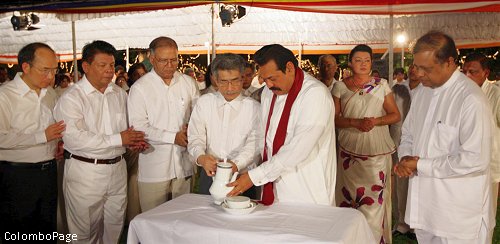
Mar 28, Colombo: Sri Lankan President Mahinda Rajapaksa and First Lady Shiranthi Rajapaksa Sunday evening held a special Buddhist ritual at the Temple Trees to offer merit to the Japanese people who lost their lives in the recent earthquake and tsunami that struck Japan.


Head of the Vidyalankara Pirivena, Most Venerable Welimitiyawe Kusaladhamma Nayaka Thera conducted the Buddha Pooja to invoke merits with the participation of a large gathering of Buddhist monks.


Sri Lanka has launched a series of Buddhist rituals to bless the victims of the earthquake and the tsunami.


The Japanese Ambassador to Sri Lanka Kunio Takahashi, Minister Bandula Gunawardena, Deputy Minister Geethanjana Gunawardena, Secretary to the President Lalith Weeratunga, and many Japanese citizens in Sri Lanka, as well as a large number of foreign nationals and Sri Lankans were also present at this religious event.


Sri Lanka offered a cash contribution of USD one million and USD 65,000 worth tea to help the tsunami victims and sent several medical teams to assist recovery efforts.

Monday, March 14, 2011

Japan's Hour of Need .. Let us Run to Help this Great and Good Nation!

By Ananda-USA
March 13, 2011

Japan has suffered a great natural diaster ... a 9.0 Richter scale earthquake that spawned a train of giant tsunami waves exceeding 10m in height. Well prepared for earthquakes though seismicity resitant design of buildings and public preparedness, Japan weathered the earthquake well with modest damage and loss of life, but suffered grievously from the tsunami that soon followed in the wake of the earthquake.

The tsunami devastated villages, towns and cities along the coast of North-Eastern Japan centered around the city of Sendai .. home to over a million people. It destroyed sea ports, air ports, homes and commercial buildings, machinery, vehicles, trains, businesses, farms, ships and fishing boats in an awesome display of nature's hidden strength. The surging water swept across bays, harbors, and fields, created vortices in which ships whirled helplessly, channeled along canals, spilled over seawalls, surmounted earthen embankments, mocking man's pitiful attempts to control nature in its fury.

As everyone watched with bated breath, and hoped that Japan's efforts at tsunami preparedness would help minimize casualties, it was not to be. The casualties first reported in the tens, jumped to hundreds, to thousands .. and now seem poised to run into the tens of thousands. Three nuclear reactors at oceanside nuclear power plants lost their ability to cool the reactor cores. They suffered partial core meltdowns, and two reactor buildings exploded due to hydrogen gas buildup. This compounded the already massive difficulties created by the tsunami with a threat of  radioactive fallout, and deprived Japan's electrical grid of the power from as many as five nuclear reactors that were needed to produce electricity to power disaster rescue and rehabilitation.

Sri Lankans, who until recently had no familiarity at all with tsunamis, except in the dim memory of a legendary ocean flood  in the days of Vihara Maya Devi, Kelani Tissa and Kavan Tissa over two millenia ago, acquired our own first hand experience in 2004 of the price that tsunamis generated by seismic events far away, across thousands of miles ocean, can exact in lost and destroyed lives and livelihoods, and levelled villages, towns, and cities. We, as a people,  know this pain well.

When Sri Lanka cried in agony at the death and destruction that the Sumatran earthquake and tsunami spawned, the Japanese people rallied to Sri Lanka's aid with food, medicine, rescue teams, helicopters, electric generators, and everything else we urgently needed. They opened their hearts and their coffers to us as few others did. It is a rare Sri Lankan family that was untouched by that disaster of Armageddon proportions.

Today, the great and good people of Japan, our allies in times both good and bad, have suffered the same fate and need help. Let us rush to their help and give generously in every possible way.

President Mahinda Rajapaksa has already dispatched Sri Lankan rescue teams to Japan (see below) and has offered whatever aid we can summon as a Nation.

That, however, is not sufficient. Let each and every one of us Sri Lankans contribute to the fullest extent to help the Japanese people in their hour of need, as if they were our own citizens of Sri Lanka. Let us do so, NOW!

Sri Lanka offers aid to devastated Japan, dispatches rescue teams


ColomboPage News Desk, Sri Lanka.
March 13, 2011

Colombo:  Sri Lanka government announced Sunday that it will donate one million US dollars to tsunami hit Japan and send a tri-forces rescue team to assist the devastated country in its recovery efforts.

Sri Lanka President Mahinda Rajapaksa today instructed the Treasury Secretary Dr. P.B. Jayasundara to take steps to release the money at the earliest through the Sri Lankan mission in Japan, the government media unit said.

A group of specially trained tri- forces rescue team will also be dispatched immediately along with a special medical team of doctors and nurses to Japan to provide medical assistance to the tsunami affected people.

Sri Lanka, having dealt with its own devastation in 2004 by the Boxing Day Indian Ocean tsunami that killed 35,000 people in the island, has the necessary experience in such rescue and relief measures.

The President has directed the Sri Lankan Envoy in Japan to coordinate all possible assistance as a friendly country to Japan.

According to Japanese officials, more than 1,400 people were killed by the Friday's magnitude 8.9 ocean earthquake that hit the eastern coast of Japan and the tsunami that followed.

The 23-foot tsunami triggered by the earthquake in the sea 80 miles off Sendai killed hundreds of people and swept away ships, planes, homes, boats and cars.

The officials however, estimate the death toll to rise over 10,000 as rescue efforts are continuing.

Japan is the single largest donor to Sri Lanka providing about two-thirds of the total donor contribution.

Friday, February 25, 2011

Lessons from global economic crisis: Need to build new financial order to better face future crises


By President Mahinda Rajapaksa
February 25, 2011


The global economic crisis taught us many lessons that varied across nations. All countries learnt both common and individual lessons, from this crisis, which left behind a trail of serious damage across nations and shook the very foundations of the financial structure of the world. It is therefore, clear that if we are to safeguard the world economy in the future, we would need to build a new financial order and a model that will better equip us to face crises of this nature, said President Mahinda Rajapaksa in his inaugural address to the 49th South East Asian Central Bank Governors’ (SEACEN) Conference, in Colombo today (25).


Commenting on the theme of the conference - “Post-Global Financial Crisis: Issues and Challenges for Central Banks of Emerging Markets” - he said that in seeking to build a new financial order much attention has been paid to regulate and supervise financial institutions which are considered to be “too big to fail”. This is indeed commendable, since the fall of major global financial institutions damages the international financial structure in a permanent manner.


“By the same token, it is also necessary for the worldwide financial community to focus upon the management of economies that have a global impact, and therefore have become “too big to fail”, he added.


Among the distinct causes that aggravated the Global Economic Crisis identified by President Rajapaksa in his address at the Central Bank of Sri Lanka were: “The blatant application of double standards; the obvious policy contradictions and inconsistencies; the stubbornness of large economies to face realities; the unfortunate attempts to politicize multi-lateral financial organizations; and the lethargy in handling urgently needed financial bail-outs”.


Referring to the search for ways to manage the current turmoil in the world economic environment in a sustainable manner, he said that “in order to be truly successful, we have to solve the economic problems of our people, who are our ultimate stakeholders. The people of our respective nations have entrusted their Governments with authority and resources to provide them with a safe economic environment where they can achieve their economic hopes and aspirations. When a country establishes a Central Bank, the people transfer a significant part of that duty and responsibility to you as well. Accordingly, as Governors, you are also responsible to the people of your respective countries”.


President Rajapaksa also said the “recent crises also taught us that existing global currencies in the SDR basket such as the US Dollar, Euro, Sterling and Yen were probably insufficient to play the role of reserve currency in turbulent times. The search for alternatives led to the price of gold and other commodities rising, creating a new set of challenges. In that scenario, we welcome the suggestion by the IMF to include market currencies such as the Chinese Renminbi in the SDR basket. However, given the distinctive nature of emerging markets, which are still to reach near optimum levels of development, it may be wise to approach this issue without pre-conditions, so as to fast track these necessary reforms in the global financial architecture”.


Referring to the regional contribution towards building a new financial order, he said: “Our region offers a wealth of experience and knowledge to the world. Let us get together and deliver upon the expectations placed upon us. Let us pledge to do all in our power to ensure that this world, with all its knowledge, technology and understanding, will never have to experience another economic crisis of this magnitude or nature again”.


Here is the text of the Address by President Mahinda Rajapaksa:


At the outset, let me thank the Board of Governors of SEACEN for inviting me to inaugurate the 46th SEACEN Governors’ Conference and High Level Seminar. It is indeed a pleasure and privilege for me to do so, and I must thank all of you for selecting Sri Lanka as your host country for this most important event. I see your presence here today as a celebration of the 60th Anniversary of the Central Bank of Sri Lanka, and as an acknowledgement of the elimination of terrorism from our midst. In this background, we do hope you have an excellent conference and fruitful meetings so that you may carry wonderful memories of our people’s progress, ability and friendship.


It is clear that the SEACEN group has become a highly influential group in the world economy today. With the very recent entry of the People’s Bank of China to this group, it has further strengthened its reach and impact across the world, and I believe SEACEN’s voice would now be even stronger.


My dear Governors, you have selected “Post-Global Financial Crisis: Issues and Challenges for Central Banks of Emerging Markets” as the theme for your deliberation at this year’s Board of Governors’ Conference. As we all know, the serious studies that have taken place on this broad topic among many central bankers, economic stakeholders, analysts and others have been extensive and wide. I believe the main reason for such in-depth attention on the subject has been that, almost all nations have suffered immensely through the crisis. Many would also carry the scars of this massive financial disaster, for many years to come.


At the same time, historians would record that Asian economies came out of this painful era in better shape than their western counterparts. Perhaps the Asian crisis in the late 90s and the subsequent counter measures implemented by the Asian economies enabled them to develop the resilience, strength and wisdom to face the new crisis in an appropriate manner. This ground reality then suggests that a better prepared country with sound macro-economic fundamentals and a strong financial system would be able to face shocks in a more successful manner, than those who may be less prepared.


My dear friends, the global economic crisis taught us many lessons. The lessons varied across nations. But all countries learnt common as well as individual lessons, from this crisis. In general, the crisis left behind, a trail of serious damage across nations and shook the very foundations of the financial structure of the world. It is therefore, clear that if we are to safeguard the world economy in the future, we would need to build a new financial order and a model that will better equip us to face crises of this nature.


In this endeavour, a lot of attention has been paid to regulate and supervise financial institutions which are considered to be “too big to fail”. This is indeed commendable, since the fall of major global financial institutions damages the international financial structure in a permanent manner. By the same token, it is also necessary for the worldwide financial community to focus upon the management of economies that have a global impact, and therefore have become “too big to fail”. We all know that certain national economies are so large and wide, their financial well-being is vital for the global economic health. In that context, it is essential that such globally influential economies should act in globally responsible manner, so as to not place themselves and indeed others, with whom they have dealings, in danger.


We may perhaps reflect on a recent case study which illustrates this position clearly.


Of late, many economic analysts have pointed out as to how the world has been anxiously watching while massive quantities of new money were injected by certain advanced nations into their economy, and through such infusion, into the entire world. It is widely expected that such infusion, while possibly stimulating growth and employment within the issuing nation, would have a massive negative impact on the rest of the world in time to come. Hence, they argue that it may have been more appropriate, if such intervention was done in consultation with multi-lateral institutions and other key players. It would have ensured that a coordinated approach could have been agreed upon, rather than being a unilateral intervention on the part of a single nation. A similar approach in relation to currency values, trade practices, country bail-outs and other structural interventions are also being advocated for the greater health of the world economy.


Your Excellencies, my dear Governors, a deep study of the crisis would reveal many defects and inconsistencies in the world economic system. The blatant application of double standards; the obvious policy contradictions and inconsistencies; the stubbornness of large economies to face realities; the unfortunate attempts to politicize multi-lateral financial organizations; and the lethargy in handling urgently needed financial bail-outs, will probably surface as distinct causes that aggravated the crisis.


We must also not be fooled into thinking that the crisis is now over. What we see at the moment is perhaps a relative calm in the world’s financial landscape, as a result of the interventions of multi-lateral organizations such as the IMF, many Governments and Central Banks. It is vital that this “calm” be made use of to implement sustainable and carefully thought-out policies to avoid a repeat of a similar or any other crisis. In my view, the highly eminent group of very senior leaders of multi-lateral institutions and influential Governors such as yourselves, would be the proper forum to deliberate such matters. The economic world therefore looks to you to propose a satisfactory way forward in the future, and we are very confident you will deliver.


My dear friends, at the end of World War 2, the IMF and the World Bank were created to safeguard the world economy and the economies of member countries in the event of an economic crisis, and to stimulate development. At the same time, nations created Central Banks in their respective countries as key financial and economic policy institutions to guide the respective countries towards stability and growth while dealing with shocks that may affect the economy. In that context, we welcome the recent efforts of the IMF to enhance the role of Special Drawing Rights (SDR) as a major reserve asset, in order to enhance worldwide currency stability.


The recent crises also taught us that existing global currencies in the SDR basket such as the US Dollar, Euro, Sterling and Yen were probably insufficient to play the role of reserve currency in turbulent times. The search for alternatives led to the price of gold and other commodities rising, creating a new set of challenges. In that scenario, we welcome the suggestion by the IMF of including emerging market currencies such as the Chinese Renminbi in the SDR basket. However, given the distinctive nature of emerging markets, which are still to reach near optimum levels of development, it may be wise to approach this issue without pre-conditions, so as to fast track these necessary reforms in the global financial architecture.


Your Excellencies, my dear Governors, it is very refreshing that we are all here in Colombo to search for ways to manage the current turmoil in the world economic environment in a sustainable manner. In order to be truly successful, we have to solve the economic problems of our people, who are our ultimate stakeholders. The people of our respective nations have entrusted their Governments with authority and resources to provide them with a safe economic environment where they can achieve their economic hopes and aspirations. When a country establishes a Central Bank, the people transfer a significant part of that duty and responsibility to you as well. Accordingly, as Governors, you are also responsible to the people of your respective countries.


At the same time, when sovereign nations subscribe to the collective objectives of a multi-lateral financial institution that pledges to maintain global economic and financial stability, a part of the sacred trust of billions of human beings, pass onto those multi-lateral institutions as well. Hence, such organizations too, shoulder a great responsibility towards the billions of people who indirectly rely upon them to make the right decisions to improve their lives. We all know that within these multi-lateral organizations whose decisions affect the entire world, those with a larger investment wield greater authority and power. Accordingly, in an indirect manner, the entire world places great trust in large powerful economies. Hence, it is perhaps time for the world economic community to remind such powerful economies that with such authority and rights, onerous duties and responsibilities also arise.


My dear friends, as the SEACEN group, it is our wish that you will be at the forefront to rebuild the world economy and proactively reform the international monetary system. Our region offers a wealth of experience and knowledge to the world. Let us get together and deliver upon the expectations placed upon us. Let us pledge to do all in our power to ensure that this world, with all its knowledge, technology and understanding, will never have to experience another economic crisis of this magnitude or nature again.


May the Blessings of the Noble Triple Gem, be with you always.


Thank you.

Thursday, February 3, 2011

It isn't the Lack of "DEMOCRACY" you fool, it's Chronic UNEMPLOYMENT. Solution is Economic Growth through Targeted Development, Education and Employable Skills: "The Youth Unemployment Bomb"

 
February 03, 2011

In Tunisia, the young people who helped bring down a dictator are called hittistes -- French-Arabic slang for those who lean against the wall. Their counterparts in Egypt, who on Feb. 1 forced President Hosni Mubarak to say he won't seek reelection, are the shabab atileen, unemployed youths. The hittistes and shabab have brothers and sisters across the globe. In Britain, they are NEETs -- "not in education, employment, or training." In Japan, they are freeters: an amalgam of the English word freelance and the German word Arbeiter, or worker. Spaniards call them mileuristas, meaning they earn no more than 1,000 euros a month. In the U.S., they're "boomerang" kids who move back home after college because they can't find work. Even fast-growing China, where labor shortages are more common than surpluses, has its "ant tribe" -- recent college graduates who crowd together in cheap flats on the fringes of big cities because they can't find well-paying work.

In each of these nations, an economy that can't generate enough jobs to absorb its young people has created a lost generation of the disaffected, unemployed, or underemployed -- including growing numbers of recent college graduates for whom the post-crash economy has little to offer. Tunisia's Jasmine Revolution was not the first time these alienated men and women have made themselves heard. Last year, British students outraged by proposed tuition increases -- at a moment when a college education is no guarantee of prosperity -- attacked the Conservative Party's headquarters in London and pummeled a limousine carrying Prince Charles and his wife, Camilla Bowles. Scuffles with police have repeatedly broken out at student demonstrations across Continental Europe. And last March in Oakland, Calif., students protesting tuition hikes walked onto Interstate 880, shutting it down for an hour in both directions.

More common is the quiet desperation of a generation in "waithood," suspended short of fully employed adulthood. At 26, Sandy Brown of Brooklyn, N.Y., is a college graduate and a mother of two who hasn't worked in seven months. "I used to be a manager at a Duane Reade (drugstore) in Manhattan, but they laid me off. I've looked for work everywhere and I can't find nothing," she says. "It's like I got my diploma for nothing."

While the details differ from one nation to the next, the common element is failure -- not just of young people to find a place in society, but of society itself to harness the energy, intelligence, and enthusiasm of the next generation. Here's what makes it extra-worrisome: The world is aging. In many countries the young are being crushed by a gerontocracy of older workers who appear determined to cling to the better jobs as long as possible and then, when they do retire, demand impossibly rich private and public pensions that the younger generation will be forced to shoulder.

In short, the fissure between young and old is deepening. "The older generations have eaten the future of the younger ones," former Italian Prime Minister Giuliano Amato told Corriere della Sera. In Britain, Employment Minister Chris Grayling has called chronic unemployment a "ticking time bomb." Jeffrey A. Joerres, chief executive officer of Manpower (NYSE:MAN - News), a temporary-services firm with offices in 82 countries and territories, adds, "Youth unemployment will clearly be the epidemic of this next decade unless we get on it right away. You can't throw in the towel on this."

The highest rates of youth unemployment are found in the Middle East and North Africa, at roughly 24 percent each, according to the International Labor Organization. Most of the rest of the world is in the high teens -- except for South and East Asia, the only regions with single--digit youth unemployment. Young people are nearly three times as likely as adults to be unemployed.

Last year the ILO caught a glimmer of hope. Poring over the data from 56 countries, researchers estimated that the number of unemployed 15- to 24-year-olds in those nations fell in 2010 by about 2 million, to just under 78 million. "At first we thought this was a good thing," says Steven Kapsos, an ILO economist. "It looked like youth were faring better in the labor market. But then what we started to realize was that labor force participation rates were plunging. Young people were just dropping out."

Youth unemployment is tempting to dismiss. The young tend to have fewer obligations, after all, and plenty of time to save for retirement. They have the health and strength to enjoy their leisure. "I spend many hours a day playing soccer with my friends," says Musa Salhi, an 18-year-old Madrid resident who studied to be an electrician but hasn't worked in over a year. Even as fighters on horses and camels galloped through Cairo's Liberation Square on Feb. 2 and the U.N. estimated that 300 people had died in a week of clashes, the world's investors continued to perceive the consequences as largely local. The Standard & Poor's 500-stock index rose 1 percent in the week following the first mass protests on Jan. 25. Crude oil prices rose less than 4 percent over the period.

But the failure to launch has serious consequences for society -- as Egypt's Mubarak and Tunisia's overthrown President, Zine al-Abidine Ben Ali, discovered. So did Iranian President Mahmoud Ahmadinejad, who in 2009 dispatched baton-wielding police against youths protesting his disputed reelection. "Educated youth have been in the vanguard of rebellions against authority certainly since the French Revolution and in some cases even earlier," says Jack A. Goldstone, a sociologist at George Mason University School of Public Policy. In December the French government released a report on the -nation's Sensitive Urban Zones, also known as banlieues, which said that the young men in the neighborhoods find it "extremely difficult" to integrate into the economic mainstream. The heavily Muslim banlieues exploded into rioting in 2005; last year a series of violent attacks there brought police face to face with youths brandishing AK-47s.

A demographic bulge is contributing to the tensions in North Africa and the Middle East, where people aged 15-29 make up the largest share of the population ever, according to multiple demographic sources. The Egyptian pyramid that matters now is the one representing the population's age structure -- wide at the young bottom, narrow at the old top. Fifteen- to 29-year-olds account for 34 percent of the population in Iran, 30 percent in Jordan, and 29 percent in Egypt and Morocco. (The U.S. figure is 21 percent.) That share will shrink because the baby boom of two decades ago was followed by a baby bust. For now, though, it's corrosive.

In a nation with a healthy economy, a burst of new talent on the scene spurs growth. But the sclerotic and autocratic states of the Middle East are ill-equipped to take advantage of this demographic dividend. Sitting at the fringes of a protest in Cairo's Liberation Square on Jan. 29 and wearing a bright yellow head scarf, Soad Mohammed Ali says she hasn't found work since graduating from Cairo University with a law degree -- nearly 10 years ago. She says the only offer of government work she has received is cleaning jobs at $40 a month. At age 30, Ali says, "I am old now."

For the young jobless, enforced leisure can be agony. Musa Salhi, the Spanish soccer player, says, "I feel bored all the time, especially in the mornings. My parents really need and want me to start working." In Belfast, Northern Ireland, 19-year-old Declan Ma--guire says he applied for 15 jobs in the past three weeks and heard nothing back. "I would consider emigrating, but I don't even have the money to do that. It is so demoralizing."

For decades, Mubarak coped with Egypt's youth unemployment problem by expanding college enrollments. That strategy couldn't last forever. This past March, scholars Ragui Assaad and Samantha Constant of the Middle East Youth Initiative, a venture of Brookings Institution and the Dubai School of Government, put it bluntly: "In Egypt, educated young people who spend years searching for formal employment, mostly in the public sector, are now forgoing this prospect as the supply of government jobs dries up. Formal private sector employment -- quite limited in the first place -- is not growing fast enough. Hence, young people are left with either precarious informal wage employment or expected to simply create a job for themselves in Egypt's vast informal economy."

Mubarak gave no sign of knowing how explosive the situation was, but his ministers did state repeatedly that Egypt needed rapid growth to soak up new job--seekers. The country started getting some things right in 2004, when Mubarak appointed a business--minded government under Prime Minister Ahmed Nazif. The nation lowered corporate taxes and import tariffs, privatized telecom, and expanded exports. The economy grew 7 percent annually from 2006 through 2008, dipped below 5 percent in 2009, and was on track for over 5 percent growth this past year, according to the International Monetary Fund.

That was good and bad. While growth is essential for easing social tensions in the long term, it can exacerbate them in the short term in a country such as Egypt. That's because, former Finance Minister Youssef Boutros-Ghali told BusinessWeek several years ago, the first fruits of growth go to those who are -already wealthy.

The lack of democracy in Egypt and elsewhere in the Middle East -- Israel being the exception -- makes -matters worse. Goldstone, of George Mason, says Mubarak is running afoul of the "paradox of autocracy," a phrase coined by the late University of California at San Diego sociologist Timothy L. McDaniel. "Any authoritarian ruler who wants to modernize his country has to educate the workforce," Goldstone says. "But when you educate the workforce you also create people who are not so willing to follow authority. Thus you create this threat of rebellion and disorder." Democracies are "much better at managing large numbers of highly educated people," Goldstone notes. Spain's youth unemployment is even higher than Egypt's, but young Spaniards aren't trying to overthrow the government.

Even so, rich democracies ignore youth unemployment at their peril. In the 34 industrialized nations in the Organization for Economic Cooperation and Development, at least 16.7 million young people are not employed, in school, or in training, and about 10 million of those aren't even looking, the OECD said in December 2010. In the most-developed nations, the job market has split between high-paying jobs that many workers aren't qualified for and low-paying jobs that they can't live on, says Harry J. Holzer, a public policy professor at Georgetown University and co-author of a new book, Where Are All the Good Jobs Going?

Many of the jobs that once paid good wages to high school graduates have been automated or outsourced.
The spike in youth unemployment should ease in the West as the after-effects of the 2008 financial crisis diminish. Eventually, growth will resume in the U.S., Europe, Japan, and other nations. The retirement of the baby boomers will increase demand for younger workers. "I believe the tables will turn. Employers will be lining up" for younger workers, says Philip J. Jennings, general secretary of UNI Global Union, an international federation of labor unions with 20 million members.

That's cold comfort to the young people who are out of work now. The short term has become distressingly long. Although the recession ended in the summer of 2009, youth unemployment remains near its cyclical peak. In the U.S., 18 percent of 16- to 24-year-olds were unemployed in December 2010, according to the Labor Dept., a year and a half after the recession technically ended. For blacks of the same age it was 27 percent. What keeps the numbers from being even higher is that many teens have simply given up. Some are sitting on couches. Others are in school, which can be a dead end itself. The percentage of American 16- to 19-year-olds who are employed has fallen to below 26 percent, a record low.

What's more, when jobs do come back, employers might choose to reach past today's unemployed, who may appear to be damaged goods, and pick from the next crop of fresh-faced grads. Starting one's career during a recession can have long-term negative consequences. Lisa B. Kahn, an economist at the Yale School of Management, estimates that for white, male college students in the U.S., a 1 percentage point increase in the unemployment rate at the time of graduation causes an initial wage loss of 6 percent to 7 percent -- and even after 15 years the recession graduates earn about 2.5 percent less than they would have if they had not come out of school during a downturn. There's a psychological impact as well. "Individuals growing up during recessions tend to believe that success in life depends more on luck than on effort, support more government redistribution, but are less confident in public institutions," conclude Paola Giuliano of UCLA's Anderson School of Management and Antonio Spilimbergo of the International Monetary Fund in a 2009 study. Downturns, the study suggests, breed self-doubting liberals.

The coincidence of protests in Egypt and record youth unemployment elsewhere has caught the attention of the world's most powerful capitalists and -diplomats. At this year's World Economic Forum in Davos, Switzerland, held while Cairo was in chaos, the hallways buzzed with can-do talk about improving -employment opportunities for the young. Even before the latest whiff of grapeshot, the U.N. declared the year beginning last August as the International Year of Youth. In December the Blackstone Group (NYSE:BX - News) and CNBC held a conference in London with top experts to discuss solutions to youth unemployment. Companies from AT&T (NYSE:T - News) to Accenture (NYSE:ACN - News) to Siemens (NYSE:SI - News) are working on ways to prepare high school and college students for the working world.

The only surefire cure for youth unemployment, however, is strong, sustained economic growth that generates so much demand for labor that employers have no choice but to hire the young. Economists have been breaking their teeth on that goal for decades. "If we knew how to get growth right we'd win the Nobel Prize," says Wendy Cunningham, a specialist in youth development at the World Bank in Washington.

In the absence of a growth panacea, economists have been working on microscale solutions, such as training programs to smooth the transition from school to work. No magic bullets there yet, either. "We seem to lack a creativity about how to address the issue. I can't point any fingers because I certainly don't have the answers," says Sara Elder, an economist at the ILO in Geneva.

One reason answers are so scarce is that rigorous measurement of antipoverty programs became widespread only in the past decade, thanks in part to the influence of economists such as Esther Duflo and Abhijit Banerjee of the Abdul Latif Jameel Poverty Action Lab, based at Massachusetts Institute of Technology. Serious analysis requires tools such as randomized trials and control groups that most bureaucrats and do-gooders don't know. And measuring long-term impact takes a decade or more.

One finding that has emerged is that more education is not always better. What matters is matching the skills of the workforce to the skills that employers demand. In Iran, where the percentage of people aged 15 and over with postsecondary degrees has soared from 2.5 percent to 10.5 percent over the past 20 years, the education system has become "a giant diploma mill," says Djavad Salehi-Isfahani, an economist at Virginia Tech. Egypt and Tunisia are headed in that direction; in 1990, only about 2 percent of their people aged 15 and over had post-secondary degrees, but by 2010 the ratios were up to 6.7 percent for Tunisia and 6 percent for Egypt, according to Harvard University's Center for International Development.

The extra schooling didn't help. Much of the anger that boiled over in the two nations, in fact, came from college graduates who couldn't put their degrees to work. Typical is Saad Mohammed, 25, a 2010 graduate of Cairo's venerable Al-Azhar University, interviewed in Liberation Square between protests. He feels betrayed that he has been unable to find work in his chosen field, "origins of religion." Mohammed hopes that "a new government will give me a job in a religious charity." The mismatch is worst for young women in the Middle East, who are getting as much advanced education as men but have far fewer job opportunities.
China, too, has produced more college diplomas than it can make use of. The number of graduates has quintupled in the past decade, and "the Chinese economy has just not been able to create that many jobs for high-skilled labor," says Anke Schrader, a researcher in Beijing at The Conference Board's China Center for Economics and Business. Manpower says that according to its analysis of the Chinese labor market, newly minted technical-school graduates are earning as much or more than new university graduates, with monthly pay of 2,000 to 4,000 renminbi a month, and in some cases 6,000 renminbi, vs. 2,000 to 2,500 for the university grads. (Monthly pay of 2,000 renminbi equals $3,600 a year at market exchange rates.)

In the U.S. and much of Europe, the problem is just the opposite of the Arab world's: not too much college education but too little. According to a study by the Organization for Economic Cooperation and Development, less-educated youth are 4.6 times as likely to be unemployed as more-educated youth in the U.S. -- a measure of the potency of knowledge in a knowledge economy. That means that the U.S. has fallen off the top of the world league table for college graduation rates at the worst possible moment. As of 2008, only 60 percent of students in American four-year schools had managed to graduate within six years, according to the National Center for Education Statistics.

Even in technologically sophisticated nations such as the U.S., college isn't for everyone. But traditional vocational programs, though popular, are not the best solution for youth unemployment, according to effectiveness research conducted by the World Bank. Cunningham, who has a PhD in labor economics and has worked in youth development at the bank since 2000, says vocational programs "often are set up without a good understanding of the demands in the labor market and become obsolete very quickly. They have staff that stay on and on. They don't have the money to update their technology."

More successful are programs that are tightly linked with employers. The Jvenes (Spanish for youths) programs in several Latin American nations require that an employer sign a document promising to take their graduates as interns, and they teach life skills alongside technical ones. Employers range from bakeries to clothing manufacturers to computer repair shops. The question, says Cunningham, is whether the Jvenes programs can be scaled up from hundreds of participants to hundreds of thousands.

These days there's a newfound appreciation for an ancient work arrangement, the apprenticeship, because it greases the transition from learning to doing. Germany and Austria experienced milder youth unemployment in the global downturn partly because of blue-collar apprenticeship programs, says Stefano Scarpetta, deputy director of the directorate of -employment, labor, and social affairs at the OECD in Paris. Last year, the International Labor Organization says, Germany's youth unemployment rate was 13.9 percent, compared with a Europe-wide average of 21.2 percent and 21 percent in the U.S.

In an update on the apprentice idea, countries such as the Netherlands encourage university students to gain work experience while enrolled. Scarpetta says 70 percent of Dutch youth ages 20-24 are getting some work experience. By contrast in Italy and Portugal only about 10 percent work while in school. The Netherlands' youth unemployment rate is just 11.2 percent.

Something similar is catching on in the U.S. AT&T, with almost 270,000 employees and an annual training budget of nearly $250 million, is trying to smooth high school students' transition to work with a program called Job Shadow that exposes students to the realities of employment. Insight into the minds of American teenagers has made AT&T executives realize the magnitude of the challenge. "I had three students shadowing me a while ago -- juniors in high school," says Charlene F. Lake, AT&T's chief sustainability officer. "When I asked them what they wanted to do after high school, two of them hadn't thought about it. One girl said she'd like to teach and expressed surprise that she needed more education to do that. She didn't even realize she had to go to college."

For many young people who lack work experience, structure is the key. "You need to have rules and regulations," says Executive Director Mary B. Mulvihill of the Grace Institute in New York, which offers tuition-free training in personal and office skills to help "under-served" women become self-sufficient. "You need to say, 'If you do this, look how your life is going to change.' If it's more loosey-goosey, I don't think it works."

If the purpose is to create jobs, as opposed to just filling them, loosey-goosey may be exactly what's needed. Entrepreneurship -- with all its guesswork and improvisation -- could be the most underexploited means of reducing youth unemployment. In 2008 the University of Miami started an entrepreneurship program called Launch Pad inside its career center to send the message that starting your own company is a valid career option, not just a class to take.

Since then, University of Miami students and recent grads have launched 45 companies. Coral Morphologic collects and raises corals for sale to aquarium owners. Sinha Astronautics has conceived of a space plane for launching satellites into low-earth orbit. Audimated, a music website, allows fans to make money by promoting their favorite indie artists. The man who launched Launch Pad is William S. Green, senior vice-provost and dean of undergraduate education. "Young people are interested in managing their own lives and are a little bit cautious about big corporations," he says. "This has become the largest single student activity on campus."

After Miami's entrepreneurship initiative caught the eye of Stephen A. Schwarzman, the billionaire head of private equity firm Blackstone Group, the Blackstone Charitable Foundation last year launched a similar program in southeastern Michigan with Wayne State University and Walsh College. On Jan. 31, as President Barack Obama announced his Startup America initiative at the White House, Blackstone said it would expand what it also calls LaunchPad to five more cities, as yet unnamed, devoting $50 million over five years. Schwarzman, buttonholed at the World Economic Forum in Davos, said Blackstone "started getting focused on this area when it became clear that (government efforts) were not in our judgment going to lead to significant declines in unemployment."

To free-market economists, one solution to youth unemployment is simple: Clear away the government-imposed obstacles to hiring young people. They blame high minimum wages, for instance, for discouraging companies from hiring promising young people who haven't had a chance to accumulate the knowledge or experience to justify being paid even the minimum wage. Following that counsel, most European countries, where minimum wages are high relative to average pay, have lower minimums for young workers. (The evidence is that high minimum wages do exclude some young people, while benefiting others by raising their pay.) Likewise, too-strong protections for the permanent workforce can hurt young people because they aren't similarly protected and bear the brunt of downsizing in hard times, the ILO warned in a 2009 report.

Right or wrong, the free-market argument hasn't carried the day: Britain and New Zealand actually raised their minimum wages during the global downturn. And the argument for the negative effect of worker protections hasn't convinced Austria and Germany, which have strong employment regulation and yet have had healthier job markets in the past two years than countries such as the U.S. with fewer worker protections. Thea Lee, deputy chief of staff at the AFL-CIO, argues that unions can't be blamed for high youth unemployment: "Business likes to have workers with no power, no rights, no protections."

That's a bit harsh. After all, company executives are squeezed too, and hiring neophytes is costly. Joerres, the Manpower chief, blames the faster pace. "Businesses did more training when the life cycle of their products and employees was longer," he says. "Now if the life cycle of your product is 18 months and it takes 12 months to bring your employee up to speed, you lose."

Chronic youth unemployment may not be fixable. But there's evidence it can be reduced through the concerted efforts of government, labor, business, education, and young people themselves. Luckily the soil is fertile: All over the world, the hittistes and shabab atileen, NEETs and freeters and boomerang kids are hungry for a chance to thrive. Says John Studzinski, senior managing director at Blackstone Group: "To a certain extent, all you can do with youth employment is plant seeds."

Sunday, January 30, 2011

‘We will not be intimidated by LTTE front organizations’ says Lankan envoy in US


article_image


LTTE front organizations will eventually be exposed and brought to justice, says Jaliya Wickramasuriya, Sri Lanka’s Ambassador to the United States. "They cannot intimidate the President or the people of Sri Lanka", he noted.

Recently foreign supporters of the LTTE terrorist group that fought and lost a conflict against the Sri Lankan people have accused President Mahinda Rajapaksa of committing war crimes as commander in chief of Sri Lanka’s armed forces, he noted. Today, LTTE supporters outside of Sri Lanka continue to accuse the government of human rights violations. Those groups continue to raise funds for violent terrorist activities.  Swiss federal police recently arrested 10 alleged LTTE supporters who police say were threatening Sri Lankan Tamils into providing money to the LTTE, Wickramasuriya said in a statement.

A number of LTTE support groups have put the word "Tamil" in their names, hoping to attract attention and avert suspicion, he said. "The LTTE, banned in the U.S. and a number of other countrie, was responsible for the murder of thousands of civilians and assassinated numerous heads of state including Sri Lanka’s then President Ranasinghe Premadasa, India’s Prime Minister Rajiv Gandhi and Sri Lanka’s Tamil Foreign Minister Lakshman Kadirgamar".

"It is clear what these groups are doing, and they have already drawn attention from law enforcement in countries where the LTTE is banned," Ambassador Wickramasuriya said. "The LTTE has tried before to raise money by using groups that pose as humanitarian organizations, and they have been caught. Those attempting to do this now must cease or face prosecution."

He said that front organizations have been discovered in the past and were brought to justice.

"Let me be clear when I say that a majority of Sri Lankans living in the U.S.- Tamil, Muslim and Sinhalese alike- are grateful to our President Rajapaksa for liberating 300,000 citizen from terrorist captivity and uniting our island," he said.  A very small group of the Sri Lankan Diaspora is made up of supporters of the LTTE terrorist group.  For the past ten or fifteen years, this small minority has been very vocal in spreading propaganda against the Government of Sri Lanka.

The Ambassador pointed out, "The LTTE, an organization that was once described by the FBI as the most ruthless terrorist organization in the world, received a majority of its funding from outside of Sri Lanka.  Over the past several years the Government of Sri Lanka worked very closely with the U.S. Department of Justice to identify the sources of this terrorist funding.  A few years ago the U.S. Department of Justice found numerous so-called charity organizations were in fact fronts for the LTTE."

In 2007 the Tamil Rehabilitation Organization (T.R.O.) was proscribed as a foreign terrorist organization after the U.S. Justice Department found that donations collected for purportedly charitable purposes were actually being spent on further militarizing the LTTE terrorists.  The U.S. Treasury Department issued a press release in 2007 noting that the "T.R.O. passed off its operations as charitable, when in fact it was raising money for a designated terrorist group responsible for heinous acts of terrorism."  The Tamil Foundation was also proscribed as a front organization, he recalled.

"What we are seeing now is that the same individuals or relatives of these individuals that were part of these proscribed LTTE front organizations have started new groups.  These so-called advocacy organizations have the same membership and directors as the proscribed organizations.  They continue to spread propaganda against the Government and carry out publicity stunts like this baseless law suit."  Wickramasuriya noted that the Government of Sri Lanka continues to work closely with the U.S. Department of Justice and other agencies in identifying LTTE front organizations.

Sunday, January 23, 2011

The Wikileaks Revelations about attitudes to Sri Lanka


By Prof. Rajiva Wijesinha
Island.lk
January 22, 20100

Reading through the revelations about Sri Lanka in Wikileaks, I am struck most of all by how they confirm the assumptions on which I have been working over the last few years.

I cannot pretend I knew all the ramifications of government policy over this period, but obviously, in fulfilling my responsibilities, as Head of the Peace Secretariat, and also Secretary to the Ministry of Disaster Management and Human Rights, I had to relate to interlocutors in terms of their essential attitudes to the Sri Lankan government.

This was particularly important since a fair amount of my work was with the international community, both in helping to coordinate international humanitarian assistance, which was a responsibility allocated to my Ministry, and also in assisting my Minister and our Ambassador in Geneva, Dayan Jayatilleka, with the various attacks on us that were being launched at the Human Rights Council.

Dayan had realized, soon after he went to Geneva in 2007, that the British were our main enemies. He was practically told as much by Nick Thorne, the then British Ambassador, and also by various others who, though they had to follow the British line, were not so happy with it. Thorne was a bit of a bully, and one did not mind responding to him forcefully.

More upsetting was the approach of his successor, who was clearly a very nice man, but permitted his young ladies, who had been trained as it were by Thorne, to be crudely, and often inaccurately, critical.

In a sense the situation was similar in Sri Lanka, where Dominic Chilcott went out on a limb to be harsh about us, in particular the Secretary of Defence. Peter Hayes, though less flamboyant, was no better, indeed probably worse, having served previously in David Miliband's private office - and not really being ambassadorial material, given his unfortunate interpersonal skills, so that he is unlikely to get any important ambassadorial position in the future.

Meanwhile other British officials, in particular the Defence Attache, seemed much nicer and more sympathetic. This did not mean they did not toe the line, but they did not adopt a sanctimonious approach as Chilcott and Hayes did.

That, unfortunately, is the trouble with the British, whom in general I love exceedingly, having spent the best years of my life amongst them. Like everyone else, they ultimately do what is best for themselves. However, having a more active conscience than others - my Chaplain claimed it was because the decision making classes were terrified of their nannies - they needed to prove to themselves that they were being high-minded.

So they get all moral about what they do, even though, as with all countries, they are essentially just fulfilling their own interests. Sometimes they get so moral that, anxious to please as we ex-colonials are, we search desperately to find out what we have done wrong.

On the whole I felt we had not done much wrong, and the British critiques were unfair. But it was nice to find this proved in the Wikileaks account of Miliband's confession to the Americans as to why he was so obsessed with Sri Lanka. Unfortunately his hyper-active period coincided with one of extreme vulnerability to such pressure on the part of the Americans.

The Obama administration was just finding its feet, and it had many officials who had preconceptions about Sri Lanka. Unable to act on their feelings about Iraq and Afghanistan, given the need for continuity that Obama could not escape, they indulged their consciences to the full with regard to Sri Lanka.

That I think explains the one blunder Hilary Clinton made, revealing what underlay her generally nuanced approach, when she made her preposterous claim about Sri Lanka using rape as a weapon of war.

Ambassador Butenis made up for that pretty smartly, and by and large I think she has confirmed my view about American policy towards Sri Lanka, which is that they have a better understanding than north Europeans of what terrorism is, and how one needs to deal with it, and that they were therefore more sympathetic to our government.

This did not mean that they were not concerned about possible Human Rights abuses. Though they know as well as we do that they have done much worse things, and sometimes as a matter of policy, in their struggle against terrorism, many officials involved in the civilized dimension of international relations do not like such things, and excuse them only because they think them essential to safeguard the American way of life.

Others, who do not enjoy such a life, have less reason to deviate from the straight and narrow, and must be judged accordingly.

Within that framework however, they were less negative, and indeed successive American ambassadors realized very soon the actual ground situation in Sri Lanka. Thus, though Robert Blake came out with preconceptions about the Karuna faction soon after he arrived here, it was not long before he realized that the real horrors were the LTTE.

We in turn should not forget that, when the Europeans, led by that other wonderful British specimen, Julian Wilson, were being negative about the East, the Americans stepped in smartly and joined our Asian friends (and a couple of the South Europeans) to help with development.

So too, while I was sorry to see Patricia Butenis too seeming to leap on the Sarath Fonseka bandwagon, who could blame her, given how extravagant were the claims made by Colombo society on his behalf, with concomitant noises presumably from the bleeding heart brigade back in Washington?

I believe however that, even if the evidence of his negative approach to politics was not apparent, she was soon disabused by her fellow Western ambassadors who, to a man (including the ladies amongst them, though not Dr Hayes) understood very well, as one of them told me, what Sarath Fonseka was about.

The other cables relating to Sri Lanka show a much more sensible approach to the Tigers than Norway for instance evinced at times. And yet, with Norway too, excepting always Mr Solheim, who I have always felt was a shady character (as was Jon-Hanssen Bauer, who was really no character at all, but seemed rather a schoolboy apprentice to Solheim, when I met them together), there was much more balance than is generally supposed.

Indeed, when the then government wanted to hand over transmitting equipment to the Tigers, the Norwegians were astonished (incidentally, as I suggested three years ago, that is a deal that should be examined further - I wonder indeed whether Ranil were not dragooned into it by his advisers, who had agendas that sometimes I think he never properly understood).

Finally, what comes out most positively is the enormous integrity of the Indians in supporting us throughout the most difficult period. Japan too comes out well, and we know China was a tower of strength, though obviously American diplomats are not in a position to let us know the inner thinking of the Chinese.

But, given the pressures on India from politicians in Tamilnadu, given the arguments of the West at a time when India was developing stronger economic ties with it, we must be grateful for India's unswerving opposition to terrorism and appeasement, and its willingness to let the Sri Lankan government go ahead with the struggle against the Tigers, when other nations were dubious about us.

In short, then, Wikileaks confirms to us that those who matter were with us when we needed them. These included the Americans, though I hope the revelations will suggest to them that they need to be less ambiguous about supporting democratic governments than those with dubious agendas advocate.

Finally, though the rot Miliband initiated may take some time to heal, and some elements in the Foreign Office will still be negative, the opportunity presented by the new British government should not be ignored.

The new British High Commissioner will have much to do, but we should accept any positive measures and reciprocate with the affection that a nation in thrall to its nannies surely deserves.

The Wikileaks Revelations about attitudes to Sri Lanka


By Prof. Rajiva Wijesinha

Reading through the revelations about Sri Lanka in Wikileaks, I am struck most of all by how they confirm the assumptions on which I have been working over the last few years.
I cannot pretend I knew all the ramifications of government policy over this period, but obviously, in fulfilling my responsibilities, as Head of the Peace Secretariat, and also Secretary to the Ministry of Disaster Management and Human Rights, I had to relate to interlocutors in terms of their essential attitudes to the Sri Lankan government.

 This was particularly important since a fair amount of my work was with the international community, both in helping to coordinate international humanitarian assistance, which was a responsibility allocated to my Ministry, and also in assisting my Minister and our Ambassador in Geneva, Dayan Jayatilleka, with the various attacks on us that were being launched at the Human Rights Council.
Dayan had realized, soon after he went to Geneva in 2007, that the British were our main enemies. He was practically told as much by Nick Thorne, the then British Ambassador, and also by various others who, though they had to follow the British line, were not so happy with it. Thorne was a bit of a bully, and one did not mind responding to him forcefully.
More upsetting was the approach of his successor, who was clearly a very nice man, but permitted his young ladies, who had been trained as it were by Thorne, to be crudely, and often inaccurately, critical.
In a sense the situation was similar in Sri Lanka, where Dominic Chilcott went out on a limb to be harsh about us, in particular the Secretary of Defence. Peter Hayes, though less flamboyant, was no better, indeed probably worse, having served previously in David Miliband's private office - and not really being ambassadorial material, given his unfortunate interpersonal skills, so that he is unlikely to get any important ambassadorial position in the future.
Meanwhile other British officials, in particular the Defence Attache, seemed much nicer and more sympathetic. This did not mean they did not toe the line, but they did not adopt a sanctimonious approach as Chilcott and Hayes did.
That, unfortunately, is the trouble with the British, whom in general I love exceedingly, having spent the best years of my life amongst them. Like everyone else, they ultimately do what is best for themselves. However, having a more active conscience than others - my Chaplain claimed it was because the decision making classes were terrified of their nannies - they needed to prove to themselves that they were being high-minded.
So they get all moral about what they do, even though, as with all countries, they are essentially just fulfilling their own interests. Sometimes they get so moral that, anxious to please as we ex-colonials are, we search desperately to find out what we have done wrong.
On the whole I felt we had not done much wrong, and the British critiques were unfair. But it was nice to find this proved in the Wikileaks account of Miliband's confession to the Americans as to why he was so obsessed with Sri Lanka. Unfortunately his hyper-active period coincided with one of extreme vulnerability to such pressure on the part of the Americans.
The Obama administration was just finding its feet, and it had many officials who had preconceptions about Sri Lanka. Unable to act on their feelings about Iraq and Afghanistan, given the need for continuity that Obama could not escape, they indulged their consciences to the full with regard to Sri Lanka.
That I think explains the one blunder Hilary Clinton made, revealing what underlay her generally nuanced approach, when she made her preposterous claim about Sri Lanka using rape as a weapon of war.
Ambassador Butenis made up for that pretty smartly, and by and large I think she has confirmed my view about American policy towards Sri Lanka, which is that they have a better understanding than north Europeans of what terrorism is, and how one needs to deal with it, and that they were therefore more sympathetic to our government.
This did not mean that they were not concerned about possible Human Rights abuses. Though they know as well as we do that they have done much worse things, and sometimes as a matter of policy, in their struggle against terrorism, many officials involved in the civilized dimension of international relations do not like such things, and excuse them only because they think them essential to safeguard the American way of life.
Others, who do not enjoy such a life, have less reason to deviate from the straight and narrow, and must be judged accordingly.
Within that framework however, they were less negative, and indeed successive American ambassadors realized very soon the actual ground situation in Sri Lanka. Thus, though Robert Blake came out with preconceptions about the Karuna faction soon after he arrived here, it was not long before he realized that the real horrors were the LTTE.
We in turn should not forget that, when the Europeans, led by that other wonderful British specimen, Julian Wilson, were being negative about the East, the Americans stepped in smartly and joined our Asian friends (and a couple of the South Europeans) to help with development.
So too, while I was sorry to see Patricia Butenis too seeming to leap on the Sarath Fonseka bandwagon, who could blame her, given how extravagant were the claims made by Colombo society on his behalf, with concomitant noises presumably from the bleeding heart brigade back in Washington?
I believe however that, even if the evidence of his negative approach to politics was not apparent, she was soon disabused by her fellow Western ambassadors who, to a man (including the ladies amongst them, though not Dr Hayes) understood very well, as one of them told me, what Sarath Fonseka was about.
The other cables relating to Sri Lanka show a much more sensible approach to the Tigers than Norway for instance evinced at times. And yet, with Norway too, excepting always Mr Solheim, who I have always felt was a shady character (as was Jon-Hanssen Bauer, who was really no character at all, but seemed rather a schoolboy apprentice to Solheim, when I met them together), there was much more balance than is generally supposed.
Indeed, when the then government wanted to hand over transmitting equipment to the Tigers, the Norwegians were astonished (incidentally, as I suggested three years ago, that is a deal that should be examined further - I wonder indeed whether Ranil were not dragooned into it by his advisers, who had agendas that sometimes I think he never properly understood).
Finally, what comes out most positively is the enormous integrity of the Indians in supporting us throughout the most difficult period. Japan too comes out well, and we know China was a tower of strength, though obviously American diplomats are not in a position to let us know the inner thinking of the Chinese.
But, given the pressures on India from politicians in Tamilnadu, given the arguments of the West at a time when India was developing stronger economic ties with it, we must be grateful for India's unswerving opposition to terrorism and appeasement, and its willingness to let the Sri Lankan government go ahead with the struggle against the Tigers, when other nations were dubious about us.
In short, then, Wikileaks confirms to us that those who matter were with us when we needed them. These included the Americans, though I hope the revelations will suggest to them that they need to be less ambiguous about supporting democratic governments than those with dubious agendas advocate.
Finally, though the rot Miliband initiated may take some time to heal, and some elements in the Foreign Office will still be negative, the opportunity presented by the new British government should not be ignored.
The new British High Commissioner will have much to do, but we should accept any positive measures and reciprocate with the affection that a nation in thrall to its nannies surely deserves.
-The Island/Asia News Network