Thursday, April 9, 2015

How Sri Lanka Won the War: Lessons in strategy from an overlooked victory

By


How to win a civil war in a globalized world where insurgents skillfully exploit offshore resources? With most conflicts now being such wars, this is a question many governments are trying to answer. Few succeed, with one major exception being Sri Lanka where, after 25 years of civil war the government decisively defeated the Liberation Tigers of Tamil Eelam (LTTE) and created a peace that appears lasting. This victory stands in stark contrast to the conflicts fought by well-funded Western forces in Iraq and Afghanistan over the last decade. How did Sri Lanka succeed against what many considered the most innovative and dangerous insurgency force in the world? Three main areas stand out.

First, the strategic objective needs to be appropriate to the enemy being fought. For the first 22 years of the civil war the government’s strategy was to bring the LTTE to the negotiating table using military means. Indeed, this was the advice foreign experts gave as the best and only option. In 2006, just before the start of the conflict’s final phase, retired Indian Lieutenant General AS Kalkat in 2006 declared, “There is no armed resolution to the conflict. The Sri Lanka Army cannot win the war against the Lankan Tamil insurgents.”
Indeed, the LTTE entered negotiations five times, but talks always collapsed, leaving a seemingly stronger LTTE even better placed to defeat government forces. In mid-2006, sensing victory was in its grasp, the LTTE deliberately ended the Norwegian-brokered ceasefire and initiated the so-called Eelam War IV. In response, the Sri Lankan government finally decided to change its strategic objective, from negotiating with the LTTE to annihilating it.

To succeed, a strategy needs to take into account the adversary. In this case it needed to be relevant to the nature of the LTTE insurgency. Over the first 22 years of the civil war, the strategies of successive Sri Lankan governments did not fulfill this criterion. Eventually, in late 2005 a new government was elected that choose a different strategic objective that matched the LTTE’s principal weaknesses while negating their strengths.
The LTTE’s principal problem was its finite manpower base. Only 12 percent of Sri Lanka’s population were Lankan Tamils and of these it was believed that only some 300,000 actively supported the LTTE.

Moreover, the LTTE’s legitimacy as an organization was declining. By 2006, the LTTE relied on conscription – not volunteers – to fill its ranks and many of these were children. At the operational level some seeming strengths could also be turned against the LTTE, including its rigid command structure, a preference for fighting conventional land battles, and a deep reliance on international support.

Grand Strategy 

Second, success requires a grand strategy. A grand strategy defines the peace sought, intelligently combines diplomacy, economics, military actions, and information operations, and considers the development of the capabilities the nation needs to succeed. The new government decided not to continue with the narrowly focused military strategies that had failed its predecessors, but rather adopt a comprehensive whole-of-nation grand strategy to guide lower-level activities.

In the economic sphere, the new government decided to allocate some 4 percent of GDP to defense and increase the armed forces budget some 40 percent. This would significantly strain the nation’s limited fiscal resources so annual grants and loans of some $1 billion were sought from China to ease the burden. Other forms of financial assistance, including lines of credit for oil and arms purchases, were provided by Iran, Libya, Russia and Pakistan.

Diplomatically, the government took steps to isolate the LTTE, which received some 60 percent of its funding and most of its military equipment from offshore. This succeeded and over time the group was banned in some 32 countries. Importantly, a close working relationship was formed with India, the only country able to meaningfully interfere with the new government’s grand strategy. The U.S. in the post-9/11 counterterrorism era also proved receptive to the government’s intentions of destroying the world’s premier suicide bomber force. America assisted by disrupting LTTE offshore military equipment procurement, sharing intelligence, providing a Coast Guard vessel, and supplying an important national naval command and control system. Canada and the European Union also came on board by outlawing the LTTE’s funding networks in their countries, severely impacting the group’s funding base.

Internally, the government set out to gain the active support of the public. By 2006 many Sri Lankans were war weary and doubted the new government’s abilities to achieve a victory no one else could. To win popular support the government realized that development activities had to be continued, not stopped while the war was fought. Moreover, various national schemes addressing poverty needed to be sustained, a prominent example being the poor farmer fertilizer subsidy scheme. These measures made financing the war very difficult and foreign financial support important, but were essential to convincing the people that there was a peace worth fighting for. The measures worked. Before 2005, the Army had difficulty recruiting 3,000 soldiers annually; by late 2008, the Army was recruiting 3,000 soldiers a month.

The increased budgets and popular support allowed the Sri Lankan armed forces to grow significantly. The Army in particular was expanded, growing from some 120,000 personnel in 2005 to more than 200,000 by 2009.

Astute Tactics

Third, to meet the ends that the grand strategy seeks, the focus of the lower-level, subordinate military strategy needed to be exploiting the enemy’s weaknesses while countering its strengths. The LTTE had limited numbers of soldiers, fielding only some 20,000-30,000, and with astute tactics could be overwhelmed. In this regard, the government forces had already won a major success before Eelam War IV started in mid-2006.

In late 2004, a senior LTTE military commander, Colonel Karuna, defected, bringing with him some 6,000 LTTE cadres and seriously damaging the LTTE’s support base in Eastern Sri Lankan. The mass defection provided crucial intelligence that offered deep insights into the LTTE as a fighting organization. Crucially, for the first time, the government intelligence agencies now had Lankan Tamils willing to return to LTTE-held areas, collect information, and report back. The scale of the defection also clearly showed that the legitimacy of the LTTE was waning.

At the start of Eelam War IV, the LTTE were able to operate throughout the country. There were no safe rear areas as high-profile suicide attacks on the foreign minister, defense secretary, the Pakistani high commissioner and the army chief underlined. This capability was countered by using the enlarged armed forces and police on internal security tasks, and by developing a Civil Defence Force of armed villagers. Operations were also conducted to find and destroy LTTE terrorist cells operating within the capital and some large towns. This defense-in-depth neutralized the LTTE’s well-proven ability to undertake both leadership decapitation strikes and terrorist attacks on vulnerable civilian targets.


These defensive measures in the south and the west of the country allowed the Sri Lankan military strategy in the north and east to be enemy-focused rather than population-centric. The primary aim there was to attack the LTTE and force them onto the defensive rather than try to protect the population from the LTTE – the conventional Western doctrine. The areas under LTTE control were accordingly attacked in multiple simultaneous operations to confuse, overload, tie down and thin out the defenders. Tactical advantage was taken of the Army’s new much greater numbers.

In these operations, small, well-trained, highly-mobile groups proved key. These groups infiltrated behind the LTTE’s front lines attacking high-value targets, providing real-time intelligence and disrupting LTTE lines of resupply and communication. Groups down to section level were trained and authorized to call in precision air, artillery and mortar attacks on defending LTTE units. The combination of frontal and in-depth assaults meant that the LTTE forces lost their freedom of maneuver, were pinned down, and could be defeated in detail.

The small groups included Special Forces operating deep and a distinct Sri Lankan innovation: large numbers of well-trained Special Infantry Operations Teams (SIOT) operating closer. The considerably expanded 10,000 strong Special Forces proved highly capable in attacking LTTE military leadership targets, removing very experienced commanders when they were most needed and causing considerable disruption to the inflexible hierarchical command system. Of the SIOTs, Army Chief General Fonseka, who introduced the concept, notes that: “we also fought with four-man teams… trained to operate deep in the jungle…. be self-reliant and operate independently. So a battalion had large numbers of four-man groups that allowed us to operate from wider fronts.” When Eelam War IV started there were 1500 SIOT trained troops; by 2008 there were more than 30,000.

Learning Organization

With enhanced training in complex jungle fighting operations, Sri Lankan solders generally became more capable, more professional, and more confident. The Army could now undertake increasingly difficult tasks day or night while maintaining a high tempo. The Army had became a ‘learning organization’ that embraced tactical level initiatives and innovations.

The LTTE was unique amongst global insurgency groups in also having a capable navy that conducted two main tasks: interdiction of government coastal shipping and logistic sea transport.

For interdiction operations the LTTE developed two classes of small, fast boats: fiberglass-hulled, attack craft armed with machine guns and grenade launchers, and low-profile, armored suicide boats fitted with contact-fused, large explosive charges. In Eelam War IV, sizeable clusters of some 30 attack craft and 8-10 suicide craft operated as swarms, mingling with local trawler fleets to make defense difficult. These were eventually defeated by even larger counter-swarms of 60-70 government fast attack craft that used targeting information from some 20 shore-based coastal radars coordinated through the command and control system the U.S. had provided.

For sea transport operations the LTTE used eleven large cargo ships that would pick up military equipment purchased from around the globe, station themselves beyond the Navy’s reach some 2,000 kms from Sri Lanka and then dash in close to the coast and quickly offload to waiting LTTE trawlers. In Eelam War IV though, the Navy used three recently acquired, second-hand offshore patrol vessels (including the donated ex-U.S. Coast Guard Cutter) combined with innovative tactics and intelligence support from India and the U.S. to strike at the LTTE’s transport ships. The last ship was sunk in late 2007 more than 3,000 km from Sri Lanka and close to Australia’s Cocos Islands.

The combination of the three factors of adopting a strategic objective matched to the adversary, using a grand strategy that focused the whole-of-the-nation on this objective, and adopting an optimized, subordinate military strategy proved devastating. The LTTE was completely destroyed. The government proved able to change its strategies in response to continuing failure and win, whereas the LTTE doggedly stuck to its previously successful formula and lost.

Some have criticized the Sri Lankan victory as only being possible because the government disregarded civilian casualties and used military force bluntly and brutally. This view correctly emphasizes that wars are by their nature cruel and violent and should not be entered into or continued lightly. However, it unhelpfully neglects critical factors and explains little. As this article has discussed, victory came to the side with the most successful strategies – even if it took the government more than 22 years to find them.

In this regard, a comparison with the two other Western-led counterinsurgency wars of the period comparing soldiers and civilians killed is instructive:

Breakdown of Overall Deaths in the Conflict
Category of those Killed Sri Lanka War (1983-2009) Iraq War
(2004-09)
Afghanistan War (2001-14)
Friendly Force Personnel 29% 17% 29%
Enemy Force Personnel 37% 22% 46%
Civilians 34% 61% 25%

These were three different civil wars that each featured counterinsurgency strategies that progressively evolved. All involved significant civilian casualties with Iraq markedly the worse with 61 percent of those killed being civilians and Afghanistan the best at 25 percent. The Sri Lankan war with 34 percent of those killed overall being civilians, and thus broadly comparable to Afghanistan, then seems somewhat unremarkable except that the Sri Lankan war was decisively won. In Iraq and Afghanistan there was no victory, there remains no peace and people continue to die.

In Sri Lanka the guns fells silent in 2009, there is 7 percent GDP growth, low unemployment, and steadily rising per capita incomes. Even an economically poor country it seems can win the peace in a civil war. The key is to focus on getting the strategy right.

Peter Layton has considerable defense experience and a doctorate in grand strategy.

Friday, January 23, 2015

“Tamilnet” Reveals Ten Point Accord for Regime Change and Executive Presidency abolition reached in 2013 at Meeting in Singapore Involving Mangala Samaraweera

The “Tamilnet”website long regarded as the mouthpiece of the Liberation Tigers of Tamil Eelam(LTTE)organization has in a news report revealed details of an alleged “understanding”involving among others the current Foreign Affairs minister Mangala Samaraweera and Tamil National Alliance(TNA)national list parliamentarian MA Sumanthiran that was arrived at in Singapore in the year 2013.

Mangala Samaraweera M.P.
The “Tamilnet” website claims that the understanding reached in 2013 formulated a conceptual framework on abolishing the executive presidency based on ten basic principles described as the “Singapore principles”. The news report further states that current Presidential adviser Dr.Jayampathy Wickramaratne, Colombo University Law professor VT Thamilmaran and unnamed representatives of the Global Tamil Forum(GTF)along with a lawyer from the Sri Lanka Muslim Congress also participated in the conclave.
The conference was organized by South Africa and funded by two European countries alleges the “Tamilnet”.
Quoting an unnamed participant in the meeting the “Tamilnet”says “Mangala Samaraweera came as a ‘beggar’ urging Tamil support for regime change and abolition of the executive presidency. It was 2013,”
M.A.Sumanthiran M.P
M.A.Sumanthiran M.P
The Tamilnet report also outlines the ten « Singapore principles » described as “hitherto unrevealed Singapore Principles of 2013”


The “Tamilnet” report of 22nd January 2015 is reproduced here in full –

Singapore Principles of 2013: Tamil polity taken for ride from Oslo to Singapore
[TamilNet, Thursday, 22 January 2015, 07:19 GMT]
Right from the Indo-Lanka agreement of 1987 to Oslo Declaration of 2002 and to hitherto unrevealed Singapore Principles of 2013 that brought the Sampanthan polity into a conceptual framework for the recent regime change in Colombo, the external forces seeking to influence the affairs of the island have taken the Eezham Tamils for a ride to confine the Tamil polity into the unitary State of genocidal Sri Lanka without securing any concrete and descriptive guarantee from the Sinhala polity. By its latest move, the ITAK has pushed the Tamils back into the past, Tamil political observers in Jaffna said citing the so-called Singapore Principles from 2013. TamilNet brings out the text of the so-called Singapore Principles for the edification of global Tamils.
All the clauses of the so-called Singapore principles are non-descriptive with regards to a principled approach in resolving the national question.
Mr M.A. Sumanthiran, the non-elected national list ITAK parliamentarian and Mr V.T. Thamilmaran, the dean of the Faculty of Law at the University of Colombo were the Tamil representatives from the island while representatives of the so-called Global Tamil Forum (GTF) were representing the Diaspora Tamils at a meeting in Singapore in 2013 when Dr Jayampathy Wickramaratne came with his proposal points to agree upon a conceptual framework aimed at regime change, the removal of Executive Presidency and other arrangements targeting good governance. Dr Jayampathy Wickramaratne was an adviser to Sri Lanka’s past two Presidents.
“Mangala Samaraweera came as a ‘beggar’ urging Tamil support for regime change and abolition of the executive presidency. It was 2013,” said one of the participants, reflecting on the Singapore meeting.
When Tamil aspirations came for discussion, M.A. Sumanthiran wanted to avoid the mentioning of terms such as Nation and Right to Self Determination in the document.
Only the voice of a human rights defender, a Sinhalese, representing the civil society, was in favour of a formula based on the recognition of nationhood to Tamil people with their traditional homeland in the North-East.
V.T. Thamilmaran, who was once respected for his principles on Tamil sovereignty, was silent and was talking only about good governance.
Tamil aspirations went missing in the proposal. Instead, the document was drafted with the intention of being non-descript. But, a consensus was achieved on winning Tamil voters through the TNA for the regime change.
A lawyer from Sri Lanka Muslim Congress was also represented at the meeting apart from several other representatives.
The meeting was organised by South Africa and was funded by two European countries.
The directors of South African ‘In Transformation Initiative’ Roelf Meyer, Ivor Jenkins and Mohammed Bhabha organised the meeting.
Ironically, the ‘approach’ of the South African outfit, according to its website is “premised on the philosophy that any solution to differences or even conflict must be designed, must evolve, and must be developed and settled domestically; solutions cannot be prescribed from external actors.”
The ‘Singapore principles’ was giving secondary status to religions other than the Buddhism.
The 10-points agreed between the Sampanthan polity and the regime changers including the new SL Foreign Minister, Mangala Samaraweera, at Singapore in 2013 follow:

Singapore Principles

1. In describing the nature of the State what is important is the substance; the labels are secondary.
2. The Constitution shall be based on basic constitutional principles and values including sovereignty of the people, participatory democracy and supremacy of the Constitution which shall form an unalterable basic structure.
3. Power sharing shall be on the basis of self-rule and shared-rule within an undivided Sri Lanka.
4. The Executive Presidency shall be abolished and the form of government shall be Parliamentary.
5. The pluralist character of Sri Lankan society as well as identities and aspirations of the constituent peoples of Sri Lanka shall be constitutionally recognised.
6. There shall be a strong and enforceable Bill of Rights consistent with universally accepted norms and standards.
7. There shall be a separation of powers and an independence of judiciary which includes a Constitutional Court.

8.
Important institutions shall be independent and accountable. Appointments to these and High Posts shall be through a transparent mechanism that provides for a national consensus, example Constitutional Council.
9. Institutions of the State shall reflect the pluralist character of Sri Lankan society.
10. The Republic of Sri Lanka shall be a secular state. The Foremost place to Buddhism and equal status to other religions shall be assured.

* * *
The controversial paragraph of the so-called Oslo Declaration of December 2002 follows:
Responding to a proposal by the leadership of the LTTE, the parties agreed to explore a solution founded on the principle of internal self-determination in areas of historical habitation of the Tamil-speaking peoples, based on a federal structure within a united Sri Lanka. The parties acknowledged that the solution has to be acceptable to all communities. [Related story with full text]
* * *
On 11 November 2011, Mr Erik Solheim was claiming that it was the UNP politician Mr Milinda Moragoda and himself, who were behind the drafting of what he termed as ‘Oslo Declaration’ in December 2002, which was signed by Mr Ranil Wickramasinge on behalf of the Government of Sri Lanka (GoSL) and by Mr Anton Balasingham on behalf of the Liberation Tigers of Tamil Eelam (LTTE).
“It was Milinda and myself who wrote that document at the [...] restaurant here in Oslo and Balasingham accepted it and he took it to Prabhakaran and Prabhakaran refused. It was not public at that time, but it was clear he was furious because he was reluctant to federalism,” Solheim said during the evaluation of the Norwegian Peace Process [Video evidence].
Mr Balasingam has recorded his version of the narrative on the subject in his book, “War and Peace: Armed Struggle and Peace Efforts of Liberation Tigers”: “[I]t must be stated that there was not any specific proclamation titled ‘Oslo Declaration’. The decision to explore federalism was included in the record of decisions at the Oslo talks and signed by the chief negotiators of both delegations and the head of the Norwegian facilitating team.” (page 403)
He further explains LTTE leader’s position that Tamils were prepared to consider favourably a political framework that offers substantial regional autonomy and self-government from the part of the Sinhala side.
But, failing the delivery of regional self-rule, the position of the LTTE leadership was that the Tamils have no alternative other than evoking the external right to self-determination. In an implied sense, Balasingham explains the objection by the LTTE leader to the exact phrasing of the paragraph in the so-called Oslo Declaration.
It was after the LTTE submitting the ISGA framework, which stressed the external dimension of the right to self-determination in its preamble and after the publishing of the War and Peace book questioning the ‘Olso Declaration,’ Mr Balasingham was brought back into the negotiations as chief negotiator by the LTTE leadership in 2006 during the Norway facilitated talks between Mahinda Rajapaksa’s GoSL and the LTTE.
While there was a leadership committed to principled political foundations, the Tamil polity had internal mechanisms to address the external manoeuvrings that sought the Tamils to abandon their principles.
But, now, the Tamil polity claiming to represent the Eezham Tamils in the homeland has no such fundamental principles or mechanisms.
The Tamil polity could be course-corrected and brought back to track only through the edification of the masses.
Courtesy:Tamilnet

Thursday, October 2, 2014

From Elephants to Blue Whales, Sri Lanka Leads the Way on Biodiversity

 
Oct 02 2014 (IPS) UNITED NATIONS- Sri Lanka will host the World Biodiversity Congress (WBC) Nov. 24-27. Given its long and active history of preserving biodiversity, it would be most appropriate for Sri Lanka to be the next host of this global event, which also marks the U.N.'s Decade on Biodiversity.

The world is confronting massive threats to its biological resources due to climate change, pollution, agricultural chemical usage and pest control, land degradation, deforestation, unbridled development, indiscriminate harvesting of wild stocks, uncontrolled slaughter, accumulating waste, in particular, slow degrading waste, etc.

Sri Lanka, while sharing many of the problems of other countries, remains strongly committed to the environment. It is no surprise that it is a party to many of the major international agreements that address environmental issues, especially biodiversity.

Sri Lanka ratified the 1992 Convention on Biological Diversity (CBD) in 1994. In 1979, it became a party to the 1973 Convention on the Conservation of Migratory Species of Wild Animals (commonly known as the Bonn Convention) and the 1973 Convention on the International Trade in Endangered Species of Wild Fauna and Flora (CITES). The decision adopted by CITES in 1989, in Lausanne, banning the trade in ivory is strictly adhered to by Sri Lanka.

These international agreements have been implemented in Sri Lanka through its own domestic efforts to protect its extensive biodiversity, which is considered to be a unique national asset. Sri Lanka boasts of many endemic species and diverse ecosystems in both its terrestrial and marine environments.

Sri Lanka's uniquely diverse range of ecosystems range from the wet and semi-dry highlands to the low-lying coast. There are grasslands, wetlands, many types of forests, including wet-zone, dry-zone and mangrove forests, lagoons, and coral reefs.

Furthermore, Sri Lanka, a country of only 65,000 square kilometres, is home to a staggering number of species of animals - some of which are endemic.

There are 91 known species of mammals, 171 species of reptiles and over 106 species of amphibians, 90 of which are endemic. Sri Lanka may be the only country in which you can see both the Earth's largest land mammal (the elephant, close to 6,000 remain in the wild according to the last count) as well as its largest marine mammal (blue and humpback whales) within a few hours of each other.

From the Sri Lankan leopard to the delicate Ceylon Rose butterfly, Sri Lanka possesses a larger percentage of endemic species than almost any other country of similar or larger land mass and is listed as a global biodiversity hotspot by the IUCN.

Protecting its biodiversity at a national level has been a key challenge and a series of measures have been taken to protect elephants, a prized national asset, including through providing two refuges for orphaned calves and facilitating captive breeding.

The country boasts a long history of training elephants for religious, commercial and domestic purposes. Elephants play a key role in Peraheras (Buddhist religious processions) where they carry the sacred relics of the Buddha with great dignity.

The annual Kandy Perahera could feature over one hundred caparisoned elephants regally parading through the streets of the ancient city of Kandy by torchlight.

Monday, July 21, 2014

India refuses visa to UN team probing Sri Lanka

 By Ananda-USA

July 21, 2014

MAYBE, just maybe, that India REFUSING A VISA to the UN team probing Sri Lanka augurs that the tide is beginning to turn in Sri Lanka's favor in Indo-Lanka relations.

I had hoped and prayed for this ever since Narendra Modi appeared on the scene as a Presidential candidate, based on his character, experience, nationalist posture, and effectiveness as a leader. I argued for receiving him warmly his acsension to his new role, as President Mahind Rajapaksa has WISELY done.

Many PATRIOTS of Lanka, myself included, have LONG RECOMMENDED that India be totally EXCLUDED from any involvement in Sri Lanka's internal matters, including its economy.

There is NO NATION in South Asia whose majority community is OVERWHELMINGLY in favor of good relations with ALL PEOPLES OF INDIA than the Sinhala Buddhist majority of Sri Lanka, which genuinely regrets the destruction of that relationship by successive myopic and egotistic Indian governments that interfered in the internal affairs of our Motherland.

Because of INDIA's actions in FOMENTING Tamil Terrorism in Sri Lanka, invading our nation militarily, and dictating how we should govern ourselves, we have drifted away from our historically close and amicable relationship with our Indian cousins.

Perhaps this DENIAL OF VISAS to Western Neocolonialist troublemakers inciting Regime Change under various PRETEXTS in Sri Lanka is a signal that India truly wants to mend Indo-Sri Lanka relations, and open a new chapter reminiscent of the Asokan Age of its hallowed past.

We Patriots of Lanka WELCOME WITH OPEN ARMS these new developments under President Narendra Modi's leadership, and await better things to come in the years and decades ahead!

.............................
India refuses visa to UN team probing Sri Lanka

ColomboPage News Desk, Sri Lanka.

July 21, Colombo: India has refused to grant visas to the United Nations team appointed by the High Commissioner for Human Rights Navi Pillay to probe the alleged human rights violations during the last seven years of three-decades long conflict in Sri Lanka.

India and four other South Asian countries have united in expressing objection to the UN probe mandated by a resolution adopted at the 25th session of the UN Human Rights Council (UNHRC) in Geneva in March 2014.

Commissioner of the Sri Lanka Human Rights Commission, Dr. Prathiba Mahanamahewa has said that India has rejected to provide visa to the investigations committee to enter that country to conduct the probe, national news agency Lankapuvath reported.

Nepal, Bangladesh, Pakistan and the Maldives have expressed their objection to the international investigation into Sri Lanka.

The investigation team appointed by Pillay to conduct a comprehensive investigation into the alleged war crimes committed by Sri Lanka's security forces and the Tamil terrorists comprises 13 members and three experts.

While conducting investigations from Western countries, the team has sought to conduct the investigations in a country close to Sri Lanka since Sri Lanka has refused to cooperate with the investigation.

"India is an important country in this regard, but India has rejected entry. Pakistan, Bangladesh, Nepal and Maldives are in a similar stance, they are not willing to provide support for a suggestion brought on an individual country. They will want to conduct investigations in a country that is close to Sri Lanka, since they cannot enter Sri Lanka," Dr. Mahanamahewa has said.

The human rights official has noted that even Afghanistan has shown their objection towards the probe. "The SAARC countries have united for the first time in this manner," Dr. Mahanamahewa added.

"The UNHRC Committee will have to conduct the investigation from outside South Asia. They will have to contact witnesses in Sri Lanka through Skype and teleconferencing," he has said.

He said refusal of visas is a very significant gesture from the part of the Indian leadership.

Pillay last month appointed Nobel Laureate Martti Ahtisaari, international judge Dame Silvia Cartwright of New Zealand, and Ms Asma Jahangir, former President of Pakistan's Supreme Court Bar Association as experts to the investigative team which will be coordinated by senior human rights official Ms. Sandra Beidas.

Earlier this month India reiterated that it is against sending the UN team to Sri Lanka to probe human rights violations allegedly committed by the Sri Lankan security forces during the decades-long war.

India's External Affairs Ministry, recalling that India abstained on the Resolution and also voted against the specific paragraph that wanted to send a team to the island, has said that the international bodies need to address human rights through a cooperative framework, not a punitive approach.

Meanwhile, the committee appointed by Navi Pillay will initiate its investigations from three different locations worldwide. Centers established in New York, Bangkok and Geneva will initiate the investigations connecting via Skype, and Satellite, the agency reported.

Wednesday, July 16, 2014

Mythical tales of Tamil persecution in Sri Lanka


By Lakshman I.Keerthisinghe LLB, LLM.MPhil, 
Attorney-at-Law 

Courtesy The Daily News
LankaWeb.com
July 15, 2014

There’s a great danger in this that we accept one side in this narrative…It’s not just a Tamil Tiger’s narrative; it’s a narrative about a complex society rebuilding itself after 35 years of vicious violence and not doing badly

-Bob Carr, Former Foreign Minster of Australia

It was recently reported in the media that Labor’s last Foreign Minister of Australia, Bob Carr, has ridiculed refugee advocates’ urban mythology” about endemic persecution of Tamils in Sri Lanka, saying the previous government couldn’t find a single case” of returned asylum-seekers being abused by authorities.

Carr, who retired from politics last October, accepted Sri Lanka’s recovery after 30 years of ethnic conflict was not a perfect exercise”, but rejected former Liberal Prime Minister Malcolm Fraser’s likening of the Abbott government’s policy to returning Jews to Nazi Germany.

Carr’s comments come as the Abbott government determines the fate of 153 Sri Lankan nationals being held aboard an Australian Customs vessel after their interception at sea. However as reported in The Australian newspaper, it is understood that the Australian government has no intention of sending the boatload to Sri Lanka, nor are authorities in Colombo preparing to receive them. Those now on board the Customs boat could be transferred to the Manus Island offshore processing centre in Papua New Guinea, the Nauru centre or repatriated to India.

Refugee advocates

Refugee advocates argue Tamils should not be returned to Sri Lanka because they fear persecution. Carr said Sri Lanka was not doing badly” given its decades-long ethnic conflict with the bloodthirsty” Tamil Tigers led by the diabolic leader Prabhakaran, whom he compared with genocidal Cambodian dictator Pol Pot. Things I’ve been hearing from the refugee lobby are simply unsustainable,” Carr, a former NSW Labor premier who served as foreign minister to Julia Gillard and Kevin Rudd, told ABC Radio. The idea that there is entrenched apartheid in the country like old South Africa or the West Bank just cannot be sustained…You’ve got 12 per cent of the population of Sri Lanka of Tamil background and they are heavily represented in the leadership of the country. You’ve got Tamil political parties sitting in the parliament, Tamil judges, Tamil doctors and engineers, a Tamil business leadership…There’s a great danger in this that we accept one side in this narrative … It’s not just a Tamil Tigers’ narrative; it’s a narrative about a complex society rebuilding itself after 35 years of vicious violence and not doing badly.

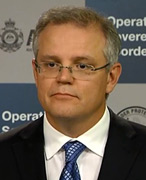
scottm Scott Morrison

Carr said the Labor government returned a boatload of Sri Lankan asylum-seekers about August 2012, none of whom were treated inhumanely. Rather, they were interviewed and then released.

There were only four issues raised with returnees by the High Commission, their position was carefully investigated and there was no mistreatment confirmed,” Carr said. There was extraordinary urban mythology promoted about their treatment. I had it put to me in a meeting with NGOs at DFAT once that there were hundreds of returnees from Australia held in detention; now that was pure myth. It’s in the interests of Sri Lanka to send a message to the world — for goodness sake, the country’s under constant close observance by the Human Rights Commission in Geneva — that in cases like this it adheres to its own law.” Carr said the international community looked the other way” during the Tamil Tigers’ bloodthirsty” insurgency.

This is a country that recovered from three-and-a-half decades of the most vicious ethnic conflict. If the Tamil Tigers had won, if they’d carved out their own republic in the north of Sri Lanka, there are good reasons for thinking … it would have ended up being very similar to Pol Pot’s regime in Cambodia. It would have been bloodthirsty…This was an insurgency that pioneered the use of suicide bombings that blew up religious monuments, children, killed people on a huge scale while the rest of the world looked the other way…The country is recovering from three-and-a-half decades of a vicious civil war and it’s not going to be a perfect exercise, and it isn’t, and we should keep our eye on human rights abuses. But I’ve got to say a lot of progress has been made.”

Asylum propaganda

Tonyabbott 
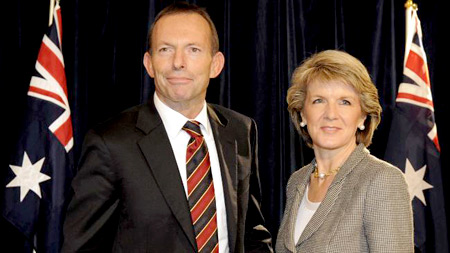
Tony Abbott and Julie Bishop


Ambassador Bandula Jayasekara, the Consul General of Sri Lanka for NSW and Queensland has said in a statement published in The Australian newspaper that vested interests were pushing asylum propaganda to profit from a lucrative trade. The Australian’s editorial of July 7 had commented that Former Prime Minister Malcolm Fraser doesn’t help his standing by likening the return of Tamils to Sri Lanka to handing over Jewish refugees to Nazi Germany. Such intemperance can only damage Mr. Fraser’s cause.” It certainly has, as has the hysterical language in the lopsided” asylum debate in Australia in the past few days.

Ambassador Jayasekera said that a misconception has been created among some Australians regarding asylum-seekers arriving from Sri Lanka because of a huge and very well-funded misinformation campaign carried out by parties with vested interests. As the representative of Sri Lanka, Jayasekera stated that he could say with complete authority that those Sri Lankans (and he emphasised, Sri Lankans — be they Sinhalese, Tamils, Muslims, Malays or Burghers) who return to Sri Lanka do not face death or torture, as the prophets of doom claim in their vicious around-the-clock campaign here in Australia.

Profitable business

Failed or returned asylum-seekers are arrested and produced before a magistrate as people who have violated the immigration laws of Sri Lanka, as any country would do. The Criminal Investigation Department of Sri Lanka, under the Sri Lankan police, questions them to see if they have a criminal record and obtains a statement from them, and they are subsequently released without delay. Jayasekera went onto say that well-organised groups who are aware of any boat coming to Australia coach prospective asylum-seekers to say they were harassed and tortured in Sri Lanka, and would be harassed and tortured if the Australian authorities were to send them back. These groups have the support of refugee councils” and refugee lawyers.

It is no secret that this has become a very profitable business — these journeys cost US $5000 to US $8000 a head — sugar-coated with the sympathy of unsuspecting Australians. Even some in the media are not aware of the racket although unfortunately certain journalists in Sydney quote nameless, faceless people raising doubts whether they were really journalists or in fact refugee advocates. At the carrying fare Jayasekera indicated, this journey would have netted some USD 1.2 million to someone (at USD 8000/- per passenger) and if those in the boat came from India as has been stated, they would have come from a refugee camp in India, where they could have followed due process and applied for political refugee status, as refugees in many camps in the world have to.

In this context, the rightful procedure now would be to return these people to where they came from, India. Failure on the part of authorities to do this would send the wrong signal to other people smugglers, if indeed the vested interest are such people. It should also be noted that this is the first vessel (boat or otherwise) that has left India carrying persons seeking political refugee status in Australia. The timing of this exercise is very suspicious as it has happened in the backdrop of the UNHRC investigation panel on Sri Lanka commencing their investigations. If the motive of the vested interest was to give the maximum negative publicity to Sri Lanka at this juncture with this incident with the support of the media including the ABC, human rights activists and refugee advocates who know nothing about Sri Lanka, and some unintelligent parliamentarians, one could say have succeeded.

Tamil Diaspora

In this respect, Australian Sri Lankans who are appalled at this one sided castigation are truly grateful to Bob Carr, Former Foreign Minister and The Australian for giving viewers another point of view besides the one sided tirade that has been leveled against Sri Lanka at the behest of the vested interests, who Sri Lankans suspect are the paid vassals of the Sri Lankan Tamil Diaspora in Tamil Nadu. It is noteworthy that Robert John “Bob” Carr (born September 28, 1947) is a former politician from Australia. A member of the Labor Party, he served in the government of Australia as Minister for Foreign Affairs from March 2012 to September 2013, while also serving in the Australian Senate as a Senator for New South Wales. From April 4, 1995 to August 3, 2005, Carr was the Premier of New South Wales. He was the longest continuously serving Premier of the state (only Sir Henry Parkes served longer, although Parkes held the office on five separate occasions).

Immigration Minister Scott Morrison has refused to comment on the two boats – one carrying 153 asylum seekers and the other carrying 50 asylum seekers – maintaining that the government does not comment on ”speculation or reporting” regarding on water operations. Asked if Australians had a right to know what was happening with asylum seekers on the two boats, Abbott said: ”The public deserve safe and secure borders…They deserve a country that has not become open for the wrong kind of business, the people smuggling business,” he told reporters in Melbourne. “Everything we do is consistent with safety at sea and everything we do is consistent with our international obligations”, the Prime Minister further stated.

The motive for these Sri Lankan asylum seekers to seek greener pastures in countries such as Australia as stated by Sri Lanka’s High Commissioner in Australia Admiral Thisara Samarasinghe is that since the ceasefire in 2009 there has been peace in Sri Lanka and thus there is no reason for any Sri Lankan to leave Sri Lanka other than economic opportunities. “There have been thousands of failed asylum seekers who have been either voluntarily or involuntarily returned to Sri Lanka. They are leading a normal life in Sri Lanka with no harassment.”

Admiral Thisara Samarasinghe, refuted claims of ongoing human rights abuses, saying those who are returned to Sri Lanka would face the magistrates court and be released on bail.

People smuggling

Foreign Minister Julie Bishop has defended the Abbott government’s asylum seeker policy after the United Nations said it was “profoundly concerned” by reports on the treatment of Tamil asylum seekers. “Australia abides by its international obligations and will continue to do so, but we will also restore our border protection laws to ensure that people do not die at sea,” Minister Bishop told the ABC.

There is nothing humanitarian about encouraging the people smuggling trade to put people on unseaworthy boats”. Indeed it is a fact that such asylum seekers pay a high price to the persons engaged in the very profitable business of people smuggling. The asylum seekers are attracted by the rosy picture painted by these smugglers in order to entice them to undertake the perilous voyage by sea along with their family members.

With the money they spend on this fruitless venture these asylum seekers could start small businesses in Sri Lanka and live happily in our motherland. It is no secret that the Tamil diaspora which operate the Tamil Refugee Agency use these asylum seekers in demonstration against Sri Lanka subsequent to their arrival in the countries in which they seek refuge. They are used as tools to bring disrepute to our motherland.

The funds for smuggling operations also are provided by these agencies. As Admiral Samarasinghe very correctly pointed out: “There is no reason for any Sri Lankan to leave Sri Lanka other than economic opportunities.” Once these asylum seekers gain employment opportunities in Western countries with the help of the diaspora they are required to commence paying part of their earnings to the diaspora organizations fattening their funds which are used to destabilize the government of Sri Lanka in the propaganda machinery set up to achieve a separate state in the north and east of Sri Lanka.

LTTE sympathizers

It heartening to note that Bob Carr and the Australian Prime Minister have assessed the true situation prevailing in Sri Lanka. The Prime Minister very correctly pointed out that: ”The Australian public deserve safe and secure borders…They deserve a country that has not become open for the wrong kind of business, the people smuggling business.” It is an open secret that these Tamil asylum seekers actively support LTTE sympathizers, who have helped them with funds to seek refuge in these Western countries.

In conclusion, Sri Lanka has to assist the Australian government in resisting attempts by greedy people smugglers from duping innocent people to risk their lives in the fruitless venture of seeking refuge under false pretexts in Australia.

Major Tamil party agrees to accept a unitary state in Sri Lanka

By Ananda-USA

July 16, 2014


If the news report below  is TRUE, and the TNA has accepted the 6th Amendment to the Constitution affirming that Sri Lanka is a UNITARY state, that INDEED is a major turnaround in the TNA's position.

However, Sri Lanka should not trust the TNA which was calling for a separatist state of Eelam in cahoots with Tamil Nadu politicians YESTERDAY, just because they have reversed their position TODAY, because they can just as well return to their separatism TOMORROW! 

This acceptance, offered as a way to avoid being found guilty in the lawsuit before the Supreme Court, could very well be another calculated ploy to gain the separatist powers they failed to get by CONFRONTATION & BLACKMAIL!

NEVER TRUST THESE LYING TRAITORS as far as you can throw a Grand Piano!

In addition, they MUST STILL BE HELD ACCOUNTABLE, PROSECUTED & PUNISHED for their TREASONOUS ACTIVITIES over the past 30 years ... INDIVIDUALLY & COLLECTIVELY as political parties, including the recent call for a SEPARATIST STATE in TNA's Election Manifesto, and affirmed by the current Chief Minister of the Northern Province.

The TNA is not saying so now because they really believe it, but because they see that the majority of Sri Lankans are FIRMLY RESOLVED to OPPOSE THEM .... COME WHAT MAY from their barking Diaspora dogs, their NGO puppets, and their Western Neo-Colonial masters plying their  own geopolitical agendas.

So, what should we Patriotic Sri Lankans do in response to this new turn of events?

Ask them to go the EXTRA MILE, and seamlessly integrate into the greater Sri Lankan Society, GIVING UP their

1. Separatist Communal party names, party constitutions and party platforms,
2. "Thesawalamai" and other Community Laws and customs that exclude Sinhala amd Muslim citizens from Tamil majority regions,
3. demands for SHARING POWER based upon Tamil ethnicity. Embrace Sri Lankan citizenship as the ONLY BASIS for rights in Sri Lanka, for communal considerations should NEVER BE a basis for Governance,
4. demands for any right not equally available to other Sri Lankan citizens,
5. opposition to other communities settling and living among them in Tamil majority areas, and INVITING and ENABLING other communities to do so just as they live among Sinhala people in the South,
5. conniving with Tamil Nadu to create a Greater Tamil Nadu incorporating Sri Lankan territories, and
6. conniving with the Racist Separatists of the Sri Lankan Tamil Diaspora in their quest to create an Eelam in Sri Lanka, and with Western Neo-Colonialists attempting to undermine and destabilize Sri Lanka for their own gain.

These are among the main ADDITIONAL things the Sri Lankan Tamil Community, and the TNA in particular, should do to REGAIN the TRUST of the MAJORITY of Sri Lankans and be ACCEPTED again as Law-Abiding Patriotic Citizens of Sri Lanka.

They should be aware that THEY WILL NOT REGAIN THE TRUST THEY LOST OVERNIGHT; it will take perhaps another 30 years of Good Sri Lankan Citizenship for that to happen.

The SECURITY & INTEGRITY of the Motherland is not something we can entrust Today to the SEPARATISTS of Yesterday, but they should GRASP the hand of FRIENDSHIP that the Sinhala people WERE ALWAYS EXTENDING TO THEM and WORK ASSIDUOUSLY to reintegrate themselves into the social fabric of Sri Lanka. That includes suppressing ALL THOSE DISRUPTIVE elements within your community, within Sri Lanka or abroad in the Diaspora, who attempt to REVIVE separatism.

Do it willingly and voluntarily now, or be marginalized forever as Sri Lanka forges ahead without you, leaving your community only the option of leaving Sri Lanka for good.

...........................
Major Tamil party agrees to accept a unitary state in Sri Lanka

 ColomboPage News Desk, Sri Lanka.
 July 16, 2014, Colombo:


Sri Lanka's main Tamil political party, Tamil National Alliance (TNA) has agreed to denounce separatism and accept a united Sri Lanka for all communities.

The TNA on Tuesday agreed to submit an affidavit to the Supreme Court, stating that Sri Lanka is a unitary State.

Lawyers appearing for the Secretary of TNA and its main constituent Tamil Arasu Kachchi (ITAK), parliamentarian Mavai Senathirajah and Leader of TNA R. Sampanthan on Tuesday (15) agreed to submit the affidavit to the Supreme Court that Sri Lanka is a unitary state when six petitions filed by representatives of Sinhala majority nationalist organizations were taken for hearing.

The six petitions filed in the apex court alleged that the political objective of the TNA is to form a separate government in Sri Lanka.

The petitioners, Galage Don Punyawardana, Gunadasa Amarasekera, U. Abeykoon, Ven. Bengamuwe Nalaka Thera, U.K. Anura and Ravi Kumar alleged that the main Tamil party campaigned for a separate state in the North and East during the Northern Provincial Council elections held in September 2013.

The petition claimed that the ITAK and TNA distributed election manifestos among voters in the North indicating that they are planning to form a separate state in Sri Lanka.

Petitioner has further cited in the petition that the manifesto is in line with the hidden agenda of the defeated Tamil terrorist organization LTTE.

In its election manifesto, the TNA, once considered as a proxy for the terrorist group LTTE during the war, has called for establishing power sharing arrangements in a unit of a merged Northern and Eastern Provinces based on a Federal structure.

The petitioners also claimed that the TNA manifesto violates the sixth amendment of the Sri Lankan Constitution which says that no political party or other association or organization shall have as one of its aims or objects the establishment of a separate State within the territory of Sri Lanka.

Under the Constitution, the Supreme Court has power to proscribe any political party or other association or organization found guilty of having the objective to establish a separate State within the territory of Sri Lanka.

TNA leaders have vehemently rejected the allegation that its election manifesto demanded a separate state of Tamil Eelam in Sri Lanka.

A three-member Bench comprising Chief Justice Mohan Peiris, Justices Rohini Marasinghe and Priyantha Jayawardana heard the petitions.

Counsels appearing for the respondents told the court that the two parties are for a unitary state in Sri Lanka and there was no intention to form a separate state. The petitioner's counsels said the agreement must be submitted to the court as an affidavit and the respondents' counsels agreed.

The Court postponed the case till 22 September.

Tuesday, July 15, 2014

THE ROVING EYE: BRICS against Washington consensus

By Pepe Escobar
ATimes.com

July 15, 2014

The headline news is that this Tuesday in Fortaleza, northeast Brazil, the BRICS group of emerging powers (Brazil, Russia, India, China, South Africa) fights the (Neoliberal) World (Dis)Order via a new development bank and a reserve fund set up to offset financial crises.

The devil, of course, is in the details of how they'll do it.

It's been a long and winding road since Yekaterinburg in 2009, at their first summit, up to the BRICS's long-awaited counterpunch against the Bretton Woods consensus - the IMF and the World Bank - as well as the Japan-dominated (but largely responding to US priorities) Asian Development Bank (ADB).

The BRICS Development Bank - with an initial US$50 billion in capital - will be not only BRICS-oriented, but invest in infrastructure projects and sustainable development on a global scale. The model is the Brazilian BNDES, which supports Brazilian companies investing across Latin America. In a few years, it will reach a financing capacity of up to $350 billion. With extra funding especially from Beijing and Moscow, the new institution could leave the World Bank in the dust. Compare access to real capital savings to US government's printed green paper with no collateral.

And then there's the agreement establishing a $100 billion pool of reserve currencies - the Contingent Reserve Arrangement (CRA), described by Russian Finance Minister Anton Siluanov as "a kind of mini-IMF". That's a non-Washington consensus mechanism to counterpunch capital flight. For the pool, China will contribute with $41 billion, Brazil, India and Russia with $18 billion each, and South Africa with $5 billion.

The development bank should be headquartered in Shanghai - although Mumbai has forcefully tried to make its case (for an Indian take on the BRICS strategy, see here )

Way beyond economy and finance, this is essentially about geopolitics - as in emerging powers offering an alternative to the failed Washington consensus. Or, as consensus apologists say, the BRICS may be able to "alleviate challenges" they face from the "international financial system". The strategy also happens to be one of the key nodes of the progressively solidified China-Russia alliance, recently featured via the gas "deal of the century" and at the St. Petersburg economic forum.

Let's play geopolitical ball
Just as Brazil managed, against plenty of odds, to stage an unforgettable World Cup - the melting of the national team notwithstanding - Vladimir Putin and Xi Xinping now come to the neighborhood to play top class geopolitical ball.

The Kremlin views the bilateral relation with Brasilia as highly strategic. Putin not only watched the World Cup final in Rio; apart from Brazilian President Dilma Rousseff, he also met German chancellor Angela Merkel (they discussed Ukraine in detail). Yet arguably the key member of Putin's traveling party is Elvira Nabiulin, president of Russia's Central Bank; she is pressing in South America the concept that all negotiations with the BRICS should bypass the US dollar.

Putin's extremely powerful, symbolic meeting with Fidel Castro in Havana, as well as writing off $36 billion in Cuban debt could not have had a more meaningful impact all across Latin America. Compare it with the perennial embargo imposed by a vengeful Empire of Chaos.

In South America, Putin is meeting not only with Uruguay's President Pepe Mujica - discussing, among other items, the construction of a deepwater port - but also with Venezuela's Nicolas Maduro and Bolivia's Evo Morales.

Xi Jinping is also on tour, visiting, apart from Brazil, Argentina, Cuba and Venezuela. What Beijing is saying (and doing) complements Moscow; Latin America is viewed as highly strategic. That should translate into more Chinese investment and increased South-South integration.

This Russia-China commercial/diplomatic offensive fits the concerted push towards a multipolar world - side by side with political/economic South American leaders. Argentina is a sterling example. While Buenos Aires, already mired in recession, fights American vulture funds - the epitome of financial speculation - in New York courthouses, Putin and Xi come offering investment in everything from railways to the energy industry.

Russia's energy industry of course needs investment and technology from private Western multinationals, just as Made in China developed out of Western investment profiting from a cheap workforce. What the BRICS are trying to present to the Global South now is a choice; on one side, financial speculation, vulture funds and the hegemony of the Masters of the Universe; on the other side, productive capitalism - an alternative strategy of capitalist development compared to the Triad (US, EU, Japan).

Still, it will be a long way for the BRICS to project a productive model independent of the casino capitalism speculation "model", by the way still recovering from the massive 2007/2008 crisis (the financial bubble has not burst for good.)

One might view the BRICS's strategy as a sort of running, constructive critique of capitalism; how to purge the system from perennially financing the US fiscal deficit as well as a global militarization syndrome - related to the Orwellian/Panopticon complex - subordinated to Washington. As Argentine economist Julio Gambina put it, the key question is not being emergent, but independent.

In this piece, La Stampa's Claudio Gallo introduces what could be the defining issue of the times: how neoliberalism - ruling directly or indirectly most of the world - is producing a disastrous anthropological mutation that is plunging us all into global totalitarianism (while everyone swears by their "freedoms").

It's always instructive to come back to Argentina. Argentina is imprisoned by a chronic foreign debt crisis essentially unleashed by the IMF over 40 years ago - and now perpetuated by vulture funds. The BRICS bank and the reserve pool as an alternative to the IMF and World Bank offer the possibility for dozens of other nations to escape the Argentine plight. Not to mention the possibility that other emerging nations such as Indonesia, Malaysia, Iran and Turkey may soon contribute to both institutions.

No wonder the hegemonic Masters of the Universe gang is uneasy in their leather chairs. This Financial Times piece neatly summarizes the view from the City of London - a notorious casino capitalism paradise.

These are heady days in South America in more ways than one. Atlanticist hegemony will remain part of the picture, of course, but it's the BRICS's strategy that is pointing the way further on down the road. And still the multipolar wheel keeps rolling along.

Pepe Escobar is the author of Globalistan: How the Globalized World is Dissolving into Liquid War (Nimble Books, 2007), Red Zone Blues: a snapshot of Baghdad during the surge (Nimble Books, 2007), and Obama does Globalistan (Nimble Books, 2009).

He may be reached at pepeasia@yahoo.com.

ADB grants $300 million to aid Sri Lanka's push to cut fuel oil use, boost renewables


ColomboPage News Desk, Sri Lanka.

July 15, Manila: The Asian Development Bank (ADB) today announced that it has approved a $300 million dual-tranche loan to help Sri Lanka scale up its use of clean energy and cut its reliance on costly petroleum oil for electricity generation.

The loan will help Sri Lanka expand the use of renewable energy for power generation and have major benefits both for poor communities and the broader economy.

"The country's heavy dependence on expensive imported petroleum oil hurts the economy, undermines energy security, and harms the environment," said ADB Principal Energy Specialist Mukhtor Khamudkhanov.

The first $150 million tranche will finance a 30-megawatt (MW), run-of-the-river hydropower plant at Moragolla in Central Province and expand and upgrade transmission lines and other infrastructure in needy areas, including the former conflict-affected Northern and Eastern Provinces. The hydropower plant will generate an additional 97.7 million units of hydropower for the grid, saving about 72,300 tons of carbon dioxide (CO2) emissions every year while improved transmission lines will further reduce annual CO2 emissions by 98,400 tons.

Environmental and social safeguards will be incorporated into the design of the program to minimize impacts, and a mechanism will be developed to guarantee downstream river flows so that sensitive fisheries, including the endangered Green Labeo, will not be adversely affected by the hydropower plant.

The second tranche, expected to be delivered in 2016, will include expanding the 33 kilovolt medium voltage network to improve distribution of electricity to consumers and the development of transmission network facilities to allow power delivery from two 100 MW wind parks due to be built in the Northern Province in 2017 and 2020.

Assistance will also be given for demand-side energy efficiency improvements including the use of smart grid and metering technologies, the retrofitting of buildings with energy saving features, and the installation of cold thermal storage in selected buildings.

The improved transmission system is expected to boost access to reliable power for about 300,000 customers in rural areas and small towns who currently suffer from low quality supplies. The program also supports Sri Lanka's wider energy investment road map, including its plan to increase the share of grid power generated from nonconventional renewable energy sources, such as mini-hydropower, wind power, and solar power, to 20% of the total by 2020.

In addition to ADB funds, there will be co-financing of up to $60 million from France's Agence Française de Développement, and counterpart funds of $80 million from the Government of Sri Lanka, for a total program cost of $440 million. The program is expected to be completed by late 2020.

BRICS create development bank, 'mini-IMF'

By Laurent Thomet
July 16, 2014

The BRICS group of emerging powers on Tuesday created a Shanghai-based development bank and a reserve fund as alternatives to Western-led institutions.

The leaders of Brazil, Russia, India, China and South Africa agreed to launch the institutions to finance infrastructure projects and head off future economic crises.

"We took the historic decision to create the BRICS bank and the reserve agreement -- an important contribution to reconfigure the system of international economic governance," Brazilian President Dilma Rousseff said at a summit in the northeastern seaside city of Fortaleza.

Russian President Vladimir Putin hailed the agreements as "a very powerful way to prevent new economic difficulties."

The five emerging nations first unveiled their plans last year. The New Development Bank aims to rival the Washington-based World Bank while the reserve is seen as a "mini-IMF."

"We need to work to improve economic governance at a global level, increase the representations and voice of developing countries," said Chinese President Xi Jinping.

Rousseff renewed calls for reform at the International Monetary Fund saying it "urgently needs to review its distribution of voting power in order to reflect the unquestionable weight of emerging countries."

- Shanghai headquarters -

The development bank will have initial capital of $50 billion that could rise to $100 billion, funded equally by each nation.

BRICS leaders agreed to put the bank's headquarters in Shanghai. The first president will be Indian while the first board chair will hail from Brazil.

An Africa Regional Center will be based in South Africa, whose President Jacob Zuma failed to convince his peers to place the bank's headquarters in Johannesburg.

The bank will help emerging and developing nations mobilize resources for infrastructure and sustainable development projects, the summit declaration said.

The Contingent Reserve Arrangement will have $100 billion at its disposal to head off potential economic volatility linked to the United States exiting its stimulus policy.

China is expected to make the biggest contribution, $41 billion, followed by $18 billion each from Brazil, India and Russia and $5 billion from South Africa.

The summit comes as the economies of some BRICS countries, which together represent 40 percent of the world population and a fifth of the global economy, are cooling down, with Russia and Brazil expecting just one percent growth this year.

Experts say the new bank and fund will give the group the backbone of a formal organization.

- Marathon summits -

The talks in Fortaleza will open a series of marathon summits and bilateral meetings in Brazil, with BRICS leaders meeting with South American presidents in Brasilia on Wednesday.

The Fortaleza summit allowed Xi and India's new Hindu nationalist Prime Minister Narendra Modi to meet face-to-face for the first time.

Modi said the BRICS must act as a "united and clear voice for a peaceful, balanced and stable world."

For Putin, who visited Argentina and Cuba before coming to Brazil, the trip has given him a chance to hammer home his calls for a "multipolar" world amid tensions with the West over the Ukraine crisis.

Russia has been kicked out of the G8 group of industrialized nations over the Ukraine crisis.

The United States is threatening to impose new economic sanctions on Russia over accusations that it is backing pro-Moscow separatist rebels in eastern Ukraine.

The BRICS summit declaration voiced "deep concern" over the situation in Ukraine and called for "comprehensive dialogue, the de-escalation of the conflict and restraint from all the actors involved, with a view to finding a peaceful political solution."

Rousseff said BRICS leaders "lament the lack of concrete progress" in Ukraine and other world hotspots, including Iraq, Syria and the Israeli-Palestinian conflict.

After Wednesday's BRICS-South America summit, Xi will launch the China-Latin America forum on Thursday, highlighting Beijing's growing interests in a region that long was seen as the back yard of the United States.

....................
 BRICS leaders create development bank

July 16, 2014

The leaders of the group of five BRICS (Brazil, Russia, India, China and South Africa) emerging market countries signed on Tuesday a deal to create a new development bank and an emergency reserve fund, Brazil's President Dilma Rousseff announced at a summit of the group here.

"The agreement towards setting up the BRICS New Development Bank is a significant step. I am happy the initiative announced in 2012 in Delhi has become a reality," Prime Minister Narendra Modi said.

The new bank will be headquartered in Shanghai, China. The first president of the bank will be from India while the first chair of the board of governors will be from Russia.

Sources said India's demand for an equal share in the bank has also been accepted.

The deal was reached after intense last-minute negotiations to settle a dispute between India and China over the headquarters of the new bank, which will have initial capital of $100 billion to invest in infrastructure projects.

The impasse reflected the difficulties that BRICS nations face in working together to build an alternative to Western-run multilateral institutions that have shaped world finances since the end of World War-II.

Failure to agree on the headquarters would have been an embarrassment for the BRICS, a group better known for its anti-Western rhetoric than agreement on concrete actions to reshape the world's financial architecture.

An official, who declined to be named, said leaders changed their positions late on Tuesday night and agreed to sign the deal.

The Curtain Must Fall on Anti-National NGOs

By Ananda-USA

July 14, 2014

Indeed the curtain must fall on the antics of these errant NGOs, prancing about as Law Unto Themselves, subject to no law, and behaving more as anti-government organizations (AGOs) than they are non-government organizations (NGOs).

There are those, especially US Diplomats, who even as they foment discord and civil disobedience in the country, spout various homilies to Sri Lanka on the need to preserve the right to “free expression” and “freedom of action” as if the players are always dutiful and not puppets manipulated from abroad, and referees are never needed to regulate the NGO game.

If that were true, why then does the US not blindly trust its own citizen investors to play by the rules even in financial markets? Why does the US have a Securities and Exchange Commission (SEC), the Treasury, and various permanent Congressional Senate and House Committees to exercise oversight, and regulate the financial and monetary markets?

We Sri Lankans also know very well how rich and powerful nations knowingly undermine, destabilize and overturn governments of other countries using “human rights” and “democrazy” as convenient balleyhooed pretexts, and destroy countless lives by converting their national refuges into absolute anarchies.
We also know that these purveyors of “human rights” and “democrazy” are experts in DOUBLE STANDARDS, doing the exact opposite of what they preach to others when their own nations are threatened.

Who has not heard of the restriction of civil liberties of US Citizens under the Patriot Act, or the Massive Spying by the National Security Administration (NSA) revealed by Edward Snowden? That spying violates the privacy protections guaranteed to American citizens by the US Constitution which now lies in tatters. While the privacy of American citizens is being violated willy-nilly, foreign citizens, both high and low, have no rights at all, as demonstrated by the NSA’s spying on Angela Merkel, the Chancellor of Germany.

In my view, the US Government, and indeed  any government, has the duty and the right to gather intelligence needed to protect the people of its nation, as necessity dictates. In that sense, the Patriot Act was quite appropriate to protect the United States in the aftermath of 9/11.

My problem is that the US does not accord the same rights to other nations and their governments to protect their own people just as the US protects Americans. Instead, they castigate, isolate, sanction and actively undermine other nations and their governments who act legitimately to protect their people.

If the United States was beset by 1426 NGOs, funded and directed by foreign nations, inimical to the United States, who are actively sowing civil discord, undermining the national government, what would the US do?

We can get some idea of what the US would do, by examning the actions the US has taken against the WikiLeaks founder Julian Assange who is not a US citizen, and Edward Snowden, a US citizen, who exposed the NSA spying.

I know what the US would do, they would SHUT DOWN, PUNISH and EXPEL all those who engage in such activities, under the treason and national security laws of the United States. And that is as it should be.

During the last 30 years, NGOs operating within Sri Lanka brought our Motherland to its knees, aiding and abetting foreign powers in their great game. They were among the principal supporters of the LTTE who prevented the early defeat and eradication of Tamil Terrorists in Sri Lanka. They are RESPONSIBLE for extending that awful war from a couple of years to three long decades, and extinguishing the lives of 150,000 lives of Sri Lanka's innocent citizens. I ACCUSE these foreign nations of that awful crime!

Today, they are playing that same game in Syria …… demolishing the government that protected its people, setting Syria’s various communities at each other’s throats, transforming the majority of its people into hapless refugees … all in the name of undermining the principal ally of Iran in the Middle East.

And here they are again, buying and selling Sri Lankan political puppets, working in collusion with the defeated Tamil Terrorists, and their surviving political proxy, the TNA, attempting to convert Sri Lanka into another Somalia, inciting and encouraging Tamil Nadu politicians to assail Sri Lanka at every turn in their quest for a Greater Tamil Nadu, pitting India against China, all driven by their FEAR of a RESURGENT China, and their perceived NEED to CONTAIN China.

It is not a useful exercise to ask whether Sri Lanka’s alliance with China, or India’s, or the Western Neo-Colonialists' interference in Sri Lanka came first. We Sri Lankans, who bore the brunt of their Machiavellian strategies,  know very well the answer to that question in the pain of our wounds and the loss of our loved ones; we need not debate it ad infinitum as if it were an interminable did the chicken or the egg come first riddle.

What is IMPORTANT, and ESSENTIAL, to Sri Lanka’s future survival is to CONTROL, OVERSEE and REGULATE the behavior of ALL NGOs, both foreign and local, whether registered under the NGO Act or the Companies Act, with the central government or with a regional government body, operating in Sri Lanka. 

Enact the laws necessary to REGULATE their behavior, and LEVY a significant SPECIAL TAX on NGOs sufficient to pay for the Government Departments and Personnel necessary to oversee and regulate their own NGO activities. Higher the tax, fewer will be the number of fly-by-night NGOs.

Examine the history of the registered NGOs, their finances and the sources of their finances, for Anti-National Activities. SHUT DOWN those who are merely in the NGO business to enrich themselves, or to engage in anti-national activities as paid tools of foreign powers. PUNISH not only the NGO as a corporate entity, but also its managers as individuals, not only with IMPRISONING the managers, but also by CONFISCATING the PERSONAL PROPERTY of the managers of ERRANT NGOs. That will go a long way towards bringing fear and discipline into the ranks of the NGOs.

In the future, apply a 3-strikes-and-you-are-out law to NGOs. The slightest infringement of the NGO Law earns them one strike, and 3-strikes will earn a SHUT DOWN, and if a foreign NGO … permanent EXPULSION of all personnel from Sri Lanka.

In these ways, we can safeguard our Resplendent Isle, our Mother Lanka, from the depredations of these parasites dancing to the tunes of foreign paymasters.

Sri Lanka tipped as Asia’s new island of growth

FT.lk
July 11, 2014


A renowned investment banking and equity markets specialist has described Sri Lanka as the new island of growth for Asia and tips the post-war rebounding nation to be the next Singapore and even do better than the region’s city state.

In an analytical article titled ‘Sell Singapore, Buy Sri Lanka’ on seekingalpha.com, specialist Fraser Dennis makes a compelling case for Sri Lanka and its future prospects.

“Singapore is showing signs that its extraordinary growth of recent years may be reaching an end as it reaches its 50th birthday. Sri Lanka is putting in place a strong foundation upon which rapid economic growth can be achieved. Two island nations with strategic locations and significant Chinese investment but high economic growth is more likely in Sri Lanka over coming years than in Singapore,” says Dennis in the article, which can be found at http://seekingalpha.com/article/2305515-sell-singapore-buy-sri-lanka.
Noting ‘why on earth should any sensible investor consider such a trade recommendation?’ and that it also may be akin to comparing apples and oranges, the specialist gives various insights and explanations backed with recent performance of Lankan economy, plans and policies underway for the future.

In his article, he states: “Let’s go back to 1956 when the father of Singapore, Lee Kwan Yew first visited Colombo, the capital of Sri Lanka. A mere nine years before Singapore independence, LKY stated that Singapore should aspire to being like Colombo. It had two universities, foreign exchange reserves, a strategically-critical location and enviable infrastructure owing to its position as a key Allied HQ during the war compared to Singapore which had been occupied by the Japanese. Step forward to today and it is Singapore that has the foreign exchange reserves, amazing infrastructure and world-renowned education and it is Sri Lanka that is recovering from a period of war….”

“However, as any sensible investor knows, in deploying capital, it is not the past that is important, but the future. As Singapore reaches the ripe old age of 50 next year, it seems likely to be Sri Lanka’s turn to produce the economic growth over the next 50 years that Singapore has produced since independence in 1965,” he added.

Dennis, who has been living and working in Asia for over 24 years, analyses Singapore’s past growth as well as future prospects and where necessary points to Sri Lanka’s future potential, emphasising that Singapore’s current and future weaknesses lead to Sri Lanka’s advantage and opportunities.

Some of the key advantages of Sri Lanka which is similar to Singapore included strategic location, new infrastructure, enormous tourism potential, a world class product in Ceylon tea, wealth of natural resources and its new economic and political allies.

“Over the past five years, a transformation has taken place around a country which promises so much,” says Dennis. “Whilst the potential of the country is clearly high, it may come as a surprise that so much has been achieved in such a short period of time since the end of the civil war? The answer is the China factor! Whilst Chinese investment may be one of the factors now hurting Singapore, it has certainly propelled Sri Lanka and looks destined to continue to support the island’s expansion,” noted the specialist.

“China recognised the strategic importance of Sri Lanka and has been the largest investor in its infrastructure expansion. Of course, this has led to tension with India, for whom Chinese influence is less attractive. However, the Sri Lankan Government of President Rajapaksa has embraced Chinese investment whilst trying to reassure India that its intentions are not inconsistent with maintaining close links to its neighbour. It isn’t just money that is flowing from China either, tourists from China increased 137% in the first half of 2014 to over 52,000,” he added.

Dennis also tips the Colombo Stock Exchange to be a future star with reforms from its current position as a “frontier market” for investors.  He also expects Foreign Direct Investments to grow in real estate, the strategic investment in tourism, energy, agriculture and minerals and other private equity investments will be joined by internationally listed opportunities for international investors to participate.

“Singapore’s reputation for its rule of law and fairness will not be matched by Sri Lanka for many years to come. Many will also be concerned by continuing investigations into the approach taken by the Sri Lankan Government in ending the civil war and by allegations of corruption within the country,” says Dennis.

“However, the question has to be posed. If the past 50 years belonged to Singapore, will the next 50 years belong to Sri Lanka? At least today, it seems likely that at least for the next few years, the growth opportunities are more likely to lie in the Indian Ocean than in the South China Sea,” concludes Dennis in his article.

Sunday, July 13, 2014

Sri Lanka - Australia relations sailing ahead: Australia broke ranks with 'world bullies' to assist Sri Lanka

By Manjula Fernando
SundayObserver.lk
July 13, 2014

The Sri Lanka's high Commissioner in Australia Admiral Thisara Samarasinghe in an interview with the Sunday Observer said Sri Lanka is unrelentingly attacked by so- called refugee advocates for the four per cent of asylum seekers from Sri Lanka when there was 60-80 per cent refugees arriving in Australia from elsewhere.


At the commissioning of the the two hi-tech patrol boats:The commissioning ceremony was held last week at the Colombo Port. The Immigration Minister Scott Morrison flew in for the ceremony graced by President Mahinda Rajapaksa and Defence Secretary Gotabaya Rajapaksa
High Commissioner in Australia Admiral Thisara Samarasinghe


"But no media, or refugee advocates criticise those countries like the way they attack Sri Lanka. You can see the disproportionate interest whipped up by the anti- Sri Lanka groups."

Admiral Samarasinghe said Sri Lanka's close relations with Australia go beyond its partnership in curbing illegal immigration, adding that the government appreciated their decision to break ranks with the West to openly condemn unfair internationalization of the challenges faced by Sri Lanka.

Excerpts of the interview,

Q: Australia and Sri Lanka seem to have entered into a new level of bi-lateral cooperation with Australia defiantly taking a position to challenge the West's opinion that Sri Lanka had conditions so worse that people wanted to flee. Your comments?

A:With the end of the conflict, Sri Lanka had a gigantic task of telling the rest of the world, how brutal and how atrocious was the terrorism that existed in Sri Lanka. Although terrorism was there for 30 years, the West in particular turned a blind eye to what was happening. Sri Lanka kept on saying this and now this is being openly acknowledged by the present Australian Government, just as the former Government did.
During the days of terrorism, President's were targeted and assassinated, Cabinet ministers and Tamil politicians were killed, places of worship and economic nerve centres were destroyed.

As for the rest of the world, it did not merit their attention. People never expected that Sri Lanka will eliminate terrorism once and for all from Sri Lanka. The western world thought separatism will succeed and were preparing for such a situation. But with the courageous lead of President Mahinda Rajapaksa, the armed forces, civilian administration collectively defeated terrorism. This is the message conveyed to Australia in very strong terms and with factual evidence.

Facts covering each area of conflict was put together and made available. This coincided with the Commonwealth Heads of Government Meeting (CHOGM) in November 2011 in Canberra. Minister Prof.G.L.Peiris termed the seven days stay of President's Rajapaksa in Canberra as one of the best diplomatic triumphs for Sri Lanka.

With that the Sri Lanka High Commission had a platform to launch and educate the Australian Federal Parliamentarians. There was extensive engagement to answer their every question.

The media which never allowed Sri Lankan high commission officials to come on TV, shifted their stance. These avenues were explored and this engagement from both sides, I would say the turning point to bring the relations to such a high level.

Q: The present Foreign Minister and the Immigration minister also toured Sri Lanka while they were in the Opposition ?

A:Yes, the Sri Lankan High Commission facilitated a visit to Sri Lanka of Foreign Minister Julie Bishop and the current Immigration Minister Scott Morrison, when they were opposition members. They were permitted to travel to any part of the country with no hindrance. A program was held in Colombo with the Government and another with the Opposition in Jaffna. They spent three days in Kilinochchi and Jaffna. All allegations of war crimes and abductions, persecution and systematic rape, were raised and answered. Minister Julie Bishop is a lawyer.

They had an opportunity to verify these allegations.When they came back they made it public that there need not be any refugees from Sri Lanka and Sri Lanka is stable, peaceful and the opportunities are enormous for right thinking, peaceful and disciplined citizens to start a life.This, I would consider as another turning point. The government changed in September last year and the same bipartisan approach to Sri Lanka continued.

Q: Former Foreign Minister Bob Carr was quoted in the Media dismissing reports that Sri Lanka abused returnees. He had said that his government did not find a single such case. Why is it that the media and refugee advocates are not willing to accept this fact?

A:That is the most disturbing aspect and it a disgrace to those organisations. Basically negative stories are given prominence - it's a bad, wrong and unfair story. These stories are spread by groups with vested interest. They are pawns of so- called human rights groups, groups indulging in human smuggling and those with the connivance of LTTE fronts.

Senator Carr, visited Sri Lanka in 2012, when they were faced with the issue of returning Sri Lankan asylum seekers. The embassy staff was allowed to travel and make inquiries. They found no concrete evidence to prove that people faced harassment.

But that was not enough to silence the so- called human rights activists and some of the media.
A Greens Party Senator came up on television saying white vans were abducting people and there was systematic rape. I challenged this person by asking the meaning of systematic rape. The reply was out of context.

She tried to quote a Sri Lankan Minister whom she said was in Australia at the time. The Minister, in fact, was not in the delegation that was visiting Australia.

She had been pumped wrong information by so- called Sri Lankan activists who are actually speaking on behalf of separatist fronts. They travel to Australia with funds coming from elusive sources to discredit the country.

There are various such bankrupt Sri Lankan groups operating in Australia. This is a serious challenge. The Sri Lankan High Commission together with the consulates in Sydney and Melbourne, and the pro Sri Lanka diaspora have been trying to counter their nonsensical claims. We have made it clear that none of the returnees will ever be subject to torture or harassment.

The bad stories will succumb in the presence of true facts. Sri Lanka has already shown that, Australian government has got over these cooked up stories.

They have been sensible and honest. Australia has broken rank from the West, not getting on board to criticise Sri Lanka. We must appreciate that stance.

Q: The latest trend seem to be refugees in India turning up at Australian shores claiming asylum status. The recent asylum boat has left Pondicherry and was reportedly carrying Lankans living in a refugee camp in India. They are neither being forced to return to Sri Lanka, nor are they being persecuted in India. Can these people be processed under the UN refugee convention?

A:They will not be considered under the UN refugee convention unless there is stark evidence of the reasons they claim. Whenever people are found attempting illegal means of entry to Australia, they are given less priority. There are genuine claimants in neighboring states, waiting to be evaluated under the Refugee Convention and come to Australia.

I will not comment on this particular asylum boat, because it is now a matter before the Australian High Court. They will tackle the new situation purely on merit, considering where the boat was detected, where they were rescued, the country of origin, and if the international UN systems are available for these people to go back to their places of origin.I must emphasise that currently there is no communication between Sri Lanka and Australia on this particular incident.

Q: It is alleged that family members of the boat people who are already living in Australia fund these illegal voyages. Can't the Australian government put a cork on such funding channels?

A:They are doing their best. From whatever the information that we have shared and they have gathered independently, Australian authorities are quite aware of an organised network. This ring is very active in abstracting false refugees. I will give one example, I am quoting the media, according to the reports the so called desperate refugees supposed to be fleeing atrocities are equipped with satellite communication, satellite roaming facilities, telephone numbers of refugee advocates, they have the confidence to contact them. We could see from that itself how well organised this racket is. Two years ago when I said these human smuggling boats coming are funded from the receiving end, I was criticised. Today I have been proved right. The Australian authorities are very much aware of it.

The influx of Sri Lankans to Australia got to the highest point with eight percent in 2012, since then it has come down to 4 per cent last year and to nothing from December last year to June this year.

But there is a 60 - 80 per cent of refugees coming from other parts of the world. But no media, or refugee advocates criticise those countries like the way they attack Sri Lanka. You can see the disproportionate interest of the organisations. This is in my opinion, are stories whipped up by groups with vested interests.
Unfortunately, one of the asylum seekers committed suicide recently, claiming that he will be tortured if returned, this incident is being exploited by the media, to bash Sri Lanka.

They are quite aware that this is a big racket and with the latest policy of Prime Minister Tony Abbot's Liberal Government, Australia has vouched to stop the arrival of illegal boats. The asylum seekers arriving now will be located in off shore processing centres in PNG and Nauru, and even the successful asylum claimants too will not be settled in Australia under their strict revised laws. Such laws have been brought in to deter Australia bound illegal sea traffic.

Q: How do you describe the claim that there are push factors in Sri Lanka to make these economic migrants to flee the country?

A:They have long realised the conditions in Australia were pull factors for illegal migrants than the push factors in the countries of origin. The push factors existed in Sri Lanka during the conflict. The LTTE was forcibly recruiting youth for fighting and forcing them to commit suicide.

The other push factor was that your life was at risk due to bomb explosions happening in the South as well as the North. With the dawn of peace these push factors have been eliminated and now only a pull factor is there.

Q: You said since December 2013 there has been no boat arrivals in Australia. What could have caused it to resume last month? The campaign to mislead people has again resumed. There are various organisations in Australia and Sri Lanka who try to convince potential victims that if you go there and in their custody, there is a good chance of settling down in Australia.

A:When questioned, failed asylum seekers who were stopped within Sri Lanka before taking off, confessed to this intention. To get qualified to stay in Australia they need to come up with a nasty story about Sri Lanka. Immigration officers had little knowledge of Sri Lanka in the past. To address this the Sri Lankan High Commission issued awareness material for immigration officers on Sri Lanka's current situation, after 2009.
The boats leaving Sri Lanka, create a negative image for the country and this is exactly what the anti Sri Lanka diaspora wants. Driven by an objective to discredit Sri Lanka, they need to maintain the flow of Lankan refugees to Australia or elsewhere.

These voyages are not funded by the asylum seekers themselves. If you are arranged a paid journey to the first world for a better standard of life, people will succumb to that. In my opinion these are the factors for the persistent flow of boats.

Q: Will it be possible to stop the flow of boat people who risk not only their life but the lives of innocent children ?

A: This will definitely come to an end provided both countries continue to show their commitment to end the flow of illegal sea migration.

I must emphasise that all this is done primarily to stop people dying at sea. Since 2009, nearly 1200 people from different countries have perished at sea trying to reach Australia on a boat, due to the work of money hungry human smugglers. It was a great achievement that there has been no deaths for the past one year.
The second achievement will be to dismantle the human smuggling network. Criminals who flourish by this unscrupulous trade. The earning capacity of smugglers are fast diminishing now, this is so much so that they are offering even free passage in some instances.

The third intention is to keep our borders intact, to stop boats from leaving or turning up illegally at our shores.

Australian and Sri Lanka set up a Joint Working Group on Human Smuggling and Transnational Crime. The Sri Lankan side of the group is led by Defence Secretary Gotabaya Rajapaksa and the Australian side is led by Secretary to the Department of Immigration and Border Protection, Martin Bowels. The first meeting of the working group was held in Colombo in December 2012.

The second meeting was held in Canberra in April this year. A 14 member delegation led by Secretary Defence and representing the Ministries of Justice and Law and Order, and the Police Department, the Coast Guard, Immigration Department, the External Affairs Ministry and the Attorney general's department took part in the meeting, also attended by their Australian counterparts. It was inaugurated by Immigration Minister Scott Morrison.

This mechanism will immensely help curb the menace of human smuggling within the region. Admiral Samarasinghe was in Sri Lanka last week to attend the commissioning of the two Patrol crafts donated by Australia to the Sri Lanka Navy. Prime Minister Tony Abbot's government took a decision to provide the two hi-tech boats with absolutely no cost to Sri Lanka. Admiral Samarasinghe said the gift was a tribute to the Sri Lanka Navy for their contribution in stopping boats with illegal asylum seekers leaving Sri Lanka.
The commissioning ceremony was held last week at the Colombo Port. The Immigration Minister Scott Morrison flew in for the ceremony graced by President Mahinda Rajapaksa and Defence Secretary Gotabaya Rajapaksa.